
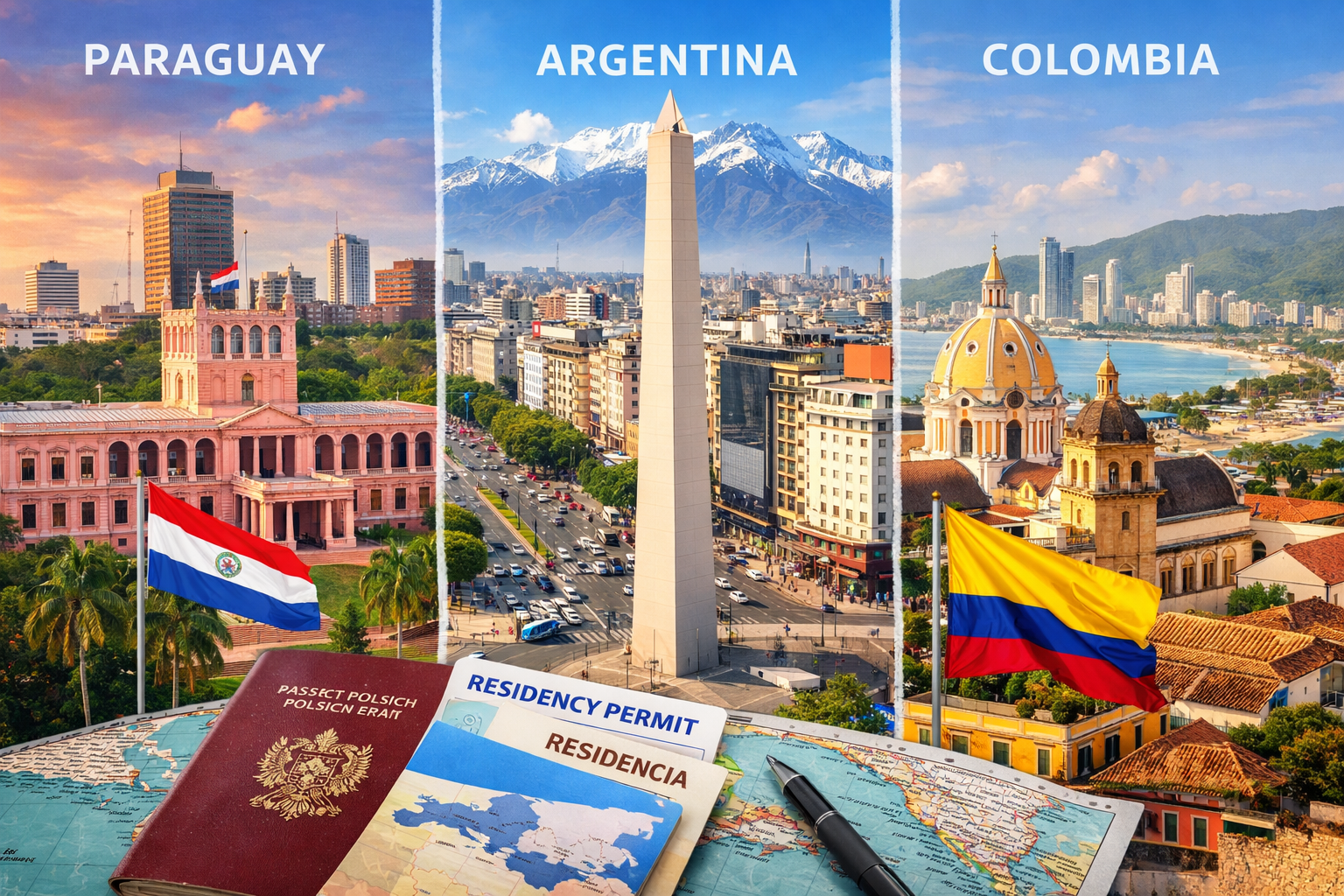
South America Residency Comparison: Paraguay, Argentina, or Colombia?
Are you considering relocating to South America in 2026? If so, you are not alone. Over the past few years, the region has become increasingly attractive for investors, remote entrepreneurs, retirees, and globally mobile families.
In particular, Paraguay, Argentina, and Colombia stand out as the leading residency destinations. Each country offers a different combination of taxation rules, residency timelines, lifestyle benefits, and long-term citizenship options.
However, choosing the right jurisdiction depends on your priorities. Are you looking for tax efficiency? Faster naturalization? Modern infrastructure? Or a low-cost base for international operations?
Let’s compare the three countries in a clear and structured way.
🇵🇾 Paraguay Residency 2026: A Territorial Tax Advantage
Why Paraguay Remains a Top Choice
In 2026, Paraguay continues to be one of the simplest residency jurisdictions in South America. Since the removal of the historical USD 5,000 bank deposit requirement, the process has become more accessible and transparent.
As a result, Paraguay attracts:
- Digital entrepreneurs
- Investors with foreign income
- Families seeking low living costs
- Individuals prioritizing tax flexibility
Most importantly, Paraguay operates under a territorial tax system.
Residency Process in Paraguay
First, applicants receive temporary residency, which is valid for two years. During this period, individuals must maintain clean legal status and demonstrate a local address.
After two years, they may apply for permanent residency, provided they show continued ties and lawful presence.
Later, naturalization may be possible through a judicial process. Citizenship is not automatic. Instead, courts evaluate:
- Physical presence
- Integration
- Economic activity
- Language ability
Processing times for temporary residency usually range between 3 and 8 months, depending on documentation and administrative workload.
Taxation in Paraguay
Unlike most countries in the region, Paraguay taxes only locally sourced income. Therefore, foreign income is generally not subject to Paraguayan taxation if it is not generated within the country.
Additionally, the maximum personal income tax rate is relatively low compared to Argentina or Colombia.
For internationally diversified individuals, this structural feature is often the deciding factor.
Lifestyle and Infrastructure
Asunción is developing rapidly. Private healthcare is expanding, real estate is modernizing, and international connectivity is improving.
Nevertheless, infrastructure remains less advanced than in Buenos Aires or Medellín. For this reason, Paraguay appeals more to those seeking stability and cost efficiency rather than large metropolitan energy.
🇦🇷 Argentina Residency 2026: Culture and Fast Naturalization
A Unique Citizenship Timeline
Argentina offers one of the fastest legal paths to citizenship globally. After two years of legal residence, applicants may petition the court for naturalization.
However, citizenship is judicial, not administrative. Consequently, approval depends on integration, clean records, and demonstrated residence.
This distinction is important.
Residency Categories in Argentina
Argentina provides several visa types:
- Rentista (passive income)
- Pensionado (retirees)
- Work visa
- Investor visa
- Student visa
Temporary residency is typically granted first. After two years of continuous legal residence, permanent residency may be requested.
Taxation in Argentina
In contrast to Paraguay, Argentina applies worldwide taxation once an individual becomes a tax resident.
Tax residency generally depends on:
- Physical presence
- Center of vital interests
- Economic activity
Therefore, high-net-worth individuals must carefully evaluate exposure before relocating.
Lifestyle Considerations
Buenos Aires offers European-style architecture, a strong cultural identity, and world-class gastronomy. Meanwhile, regions like Mendoza and Patagonia provide natural beauty and lower density living.
Public healthcare and university education are accessible to residents. However, inflation and currency volatility remain structural factors to consider.
🇨🇴 Colombia Residency 2026: Structured and Modern
A Clear Visa Framework
Colombia operates a structured visa system. Most applicants begin with a Migrant (M) visa, which can later lead to permanent Resident (R) status.
Common categories include:
- Pensionado visa
- Investor visa
- Work visa
- Marriage visa
The pensionado visa requires income equal to three times the Colombian minimum wage. Because the minimum wage is indexed annually, thresholds change each year.
Similarly, investor visa requirements are calculated in multiples of the minimum wage rather than a fixed USD amount.
Permanent Residency Timeline
After five years of continuous Migrant status, individuals may apply for Resident status. However, long absences from Colombia can interrupt eligibility.
Therefore, presence planning is critical.
Taxation in Colombia
Colombia uses a worldwide tax system. Tax residency is generally triggered by spending 183 days or more in the country within a 365-day period.
Consequently, individuals who divide time between countries must monitor physical presence carefully.
Comparison Table: Residency in 2026
| Factor | Paraguay | Argentina | Colombia |
|---|---|---|---|
| Tax System | Territorial | Worldwide | Worldwide |
| Temporary Residency | 2 years | 1 year | Up to 3 years |
| Permanent Residency | After 2 years | After 2 years | After 5 years |
| Citizenship Eligibility | Multi-year, judicial | 2 years legal residence | 5+ years typically |
| Bureaucracy Level | Low | Moderate–High | Moderate |
| Cost of Living | Very Low | Moderate | Moderate |
| Infrastructure | Developing | Advanced | Advanced |
Immigration Residency vs Tax Residency
It is important to distinguish between immigration status and tax status.
Holding a residency card does not automatically create tax residency. Instead, tax obligations depend on physical presence and economic ties.
This distinction often determines whether Paraguay, Argentina, or Colombia is the better long-term option.
Which Country Is Best in 2026?
Choose Paraguay if you prioritize territorial taxation, low bureaucracy, and cost efficiency.
Choose Argentina if you value culture and want one of the fastest legal paths to naturalization.
Choose Colombia if you prefer modern infrastructure and structured visa categories.
Ultimately, the best choice depends on your tax profile, business structure, physical presence plans, and long-term goals.
South America as a Strategic Residency Region
In 2026, South America offers real strategic alternatives for globally mobile individuals. However, residency decisions should never be based solely on lifestyle marketing.
Instead, evaluate:
- Tax exposure
- Residency maintenance requirements
- Citizenship eligibility
- Physical presence rules
- Economic stability
When structured properly, South America can provide both lifestyle value and strategic diversification.


Leave a Reply