
The Region’s Highest Long-Term GDP Growth in Over 60 Years
For decades, Paraguay remained largely absent from mainstream discussions about South America’s economy. Global media focused on Brazil, Argentina, or Chile, while Paraguay followed a markedly different path: steady, incremental development, free from dramatic policy swings, recurring currency collapses, or headline-grabbing experiments.
The results of that strategy become strikingly clear when viewed through long-term data.
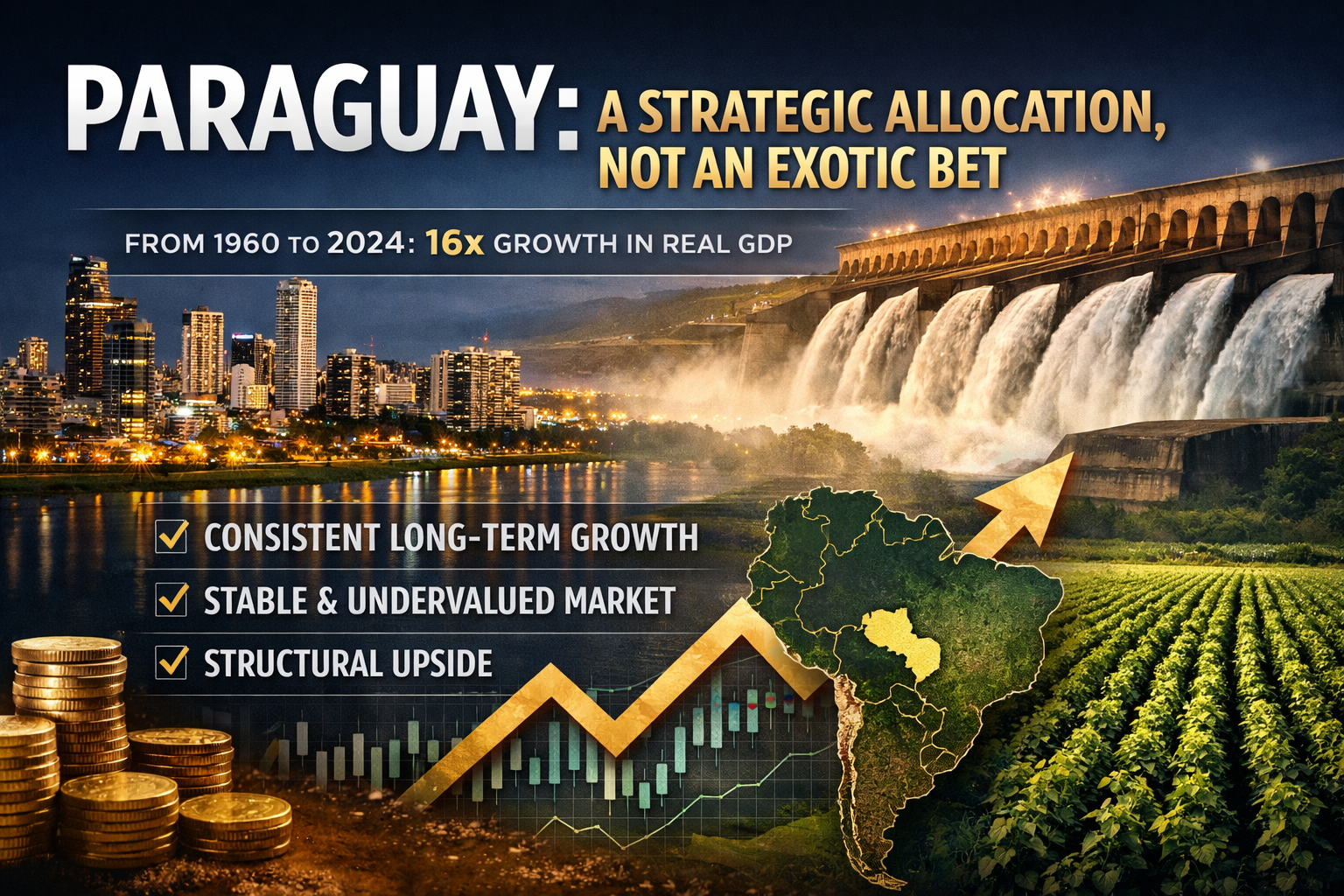
According to World Bank data analyzed by Forbes Paraguay, Paraguay’s real Gross Domestic Product expanded more than 16-fold between 1960 and 2024. No other South American country recorded a higher cumulative GDP increase over the same period.

Paraguay’s GDP in Context: What the Numbers Actually Show
Paraguay’s GDP (constant 2015 USD):
- 1960: USD 2.84 billion
- 2024: USD 46.0 billion
These figures are calculated in constant dollars, meaning they are adjusted for inflation. This is not a cosmetic detail—it fundamentally changes how growth should be interpreted.
In real terms, Paraguay today produces over sixteen times more goods and services than it did in 1960. The cumulative increase of 1,519.9% reflects genuine economic expansion, not accounting tricks or currency devaluation.
Why Constant Dollars Matter
Comparing GDP using nominal dollars would lead to distorted conclusions, because:
- The purchasing power of the dollar in 1960 was far higher,
- Inflation mechanically inflates nominal growth figures,
- Long-term comparisons become misleading.
Constant dollars act as a single, unchanging measuring stick. They reveal how much an economy has actually grown in real output, productivity, infrastructure, and energy capacity.
Paraguay’s performance under this metric confirms sustained, tangible development—not a statistical illusion.
Paraguay Versus the Region: A Structural Outlier
Cumulative real GDP growth, 1960–2024:
- Colombia: +1,086%
- Chile: +996.7%
- Brazil: +976.1%
- Peru: +734.6%
- Bolivia: +699.7%
- Argentina: +287.1%
- Uruguay: +282.5%
- Venezuela: +28.4%
The key distinction is not just speed, but continuity. Many countries in the region experienced powerful growth cycles, only to see them erased by currency crises, inflationary spirals, or political shocks. Paraguay largely avoided these resets.
The Four Pillars Behind Paraguay’s Long-Term Growth
1. Absence of Chronic Macroeconomic Crises
Paraguay avoided:
- Hyperinflation episodes that destroyed savings,
- Bank deposit confiscations,
- Widespread nationalizations,
- Violent currency collapses.
This stability allowed capital to accumulate rather than flee—a rare advantage in South America.
2. Conservative Fiscal Policy
For decades, the country:
- Maintained relatively low public debt,
- Avoided debt-fuelled growth models,
- Treated macroeconomic stability as a development prerequisite.
In a region known for fiscal volatility, this restraint proved unusually effective.
3. A Real Economy Built on Production
Paraguay’s growth has been driven by:
- Agriculture and exports (notably soy and beef),
- Abundant, low-cost energy from hydroelectric power, including Itaipú Dam,
- Logistics and light manufacturing,
- Highly competitive labor and land costs.
This is a “hard” economy—grounded in tangible production and energy flows, not financial speculation.
4. Demographics and Urbanization: Paraguay’s Underappreciated Growth Engine
One of Paraguay’s most overlooked advantages is demographic structure. Unlike aging economies in Europe or parts of Latin America, Paraguay remains relatively young.
Why a Young Population Matters
A youthful demographic profile means:
- A larger working-age population,
- More entrants into the labor market,
- Strong demand for housing, services, education, and infrastructure,
- Lower pressure on pension and healthcare systems.
Aging societies finance the past. Paraguay is still building the future.
Urbanization: A Process Still Gaining Momentum
Historically, Paraguay had a low urbanization rate. Large segments of the population lived outside major cities, limiting:
- Demand for modern housing,
- Development of advanced services,
- Urban infrastructure investment.
That dynamic is now changing.
Urbanization is not a cost—it is a development phase. As people:
- Move to cities,
- Shift into non-agricultural employment,
- Consume more services,
- Invest in housing,
overall productivity rises.
Asunción and the Metropolitan Shift
The transformation is most visible in Asunción and its surrounding metropolitan area:
- Rapid expansion of residential construction,
- Rising demand for multi-family apartments,
- Influx of young workers from regional areas,
- Growth in services, gastronomy, coworking spaces, and offices.
This marks a classic transition:
from a low-urbanization economy → to an emerging urban growth market
Historically, this phase coincides with the strongest increases in real estate values, productivity, and household incomes.
Real Estate and Land Prices: A Reflection of Timing, Not Weakness
Relatively low property prices in Paraguay are not a sign of market fragility. They reflect:
- Later onset of urbanization,
- Lower historical demographic pressure on cities,
- A market only now entering accelerated growth.
As young demographics urbanize, this balance shifts—something already visible in Asunción’s price dynamics.
Why Demographics and Urbanization Reinforce Each Other
The critical factor is the interaction:
- Young population → demand for jobs, housing, and services,
- Cities → productivity, infrastructure, and scale,
- Low starting point → room for sustained growth.
This combination places Paraguay at an early, but highly promising, stage of the development cycle.
Paraguay benefits from a rare alignment: a young population and an urbanization process that is still accelerating rather than maturing.
GDP Growth and Living Standards: A Necessary Clarification
Paraguay’s income per capita remains lower than that of some regional peers. This does not undermine the growth narrative.
On the contrary:
- The economy is still in a catch-up phase,
- Productivity gains are far from exhausted,
- Significant qualitative growth potential remains.
For investors and entrepreneurs, such conditions often present better entry points than mature, saturated markets.
Why These Numbers Matter Now
They demonstrate that Paraguay:
- Is not a one-off statistical anomaly,
- Does not rely on risky policy experiments,
- Has over six decades of documented, real economic expansion.
In an era of recurring global crises, long-term stability is an increasingly scarce asset.
Paraguay: A Strategic Allocation, Not an Exotic Bet
A sixteen-fold increase in real GDP between 1960 and 2024 positions Paraguay as the most consistently expanding economy in South America over the long term. This performance is not the product of cyclical booms or speculative surges, but of disciplined policy, macroeconomic restraint, and an economy anchored in real production.
For long-term thinkers, Paraguay has moved beyond the realm of curiosity. It represents a quantifiable, rational, and increasingly intentional economic and investment allocation—one defined by stability, underpricing, and structural upside rather than short-term narratives.


Leave a Reply