
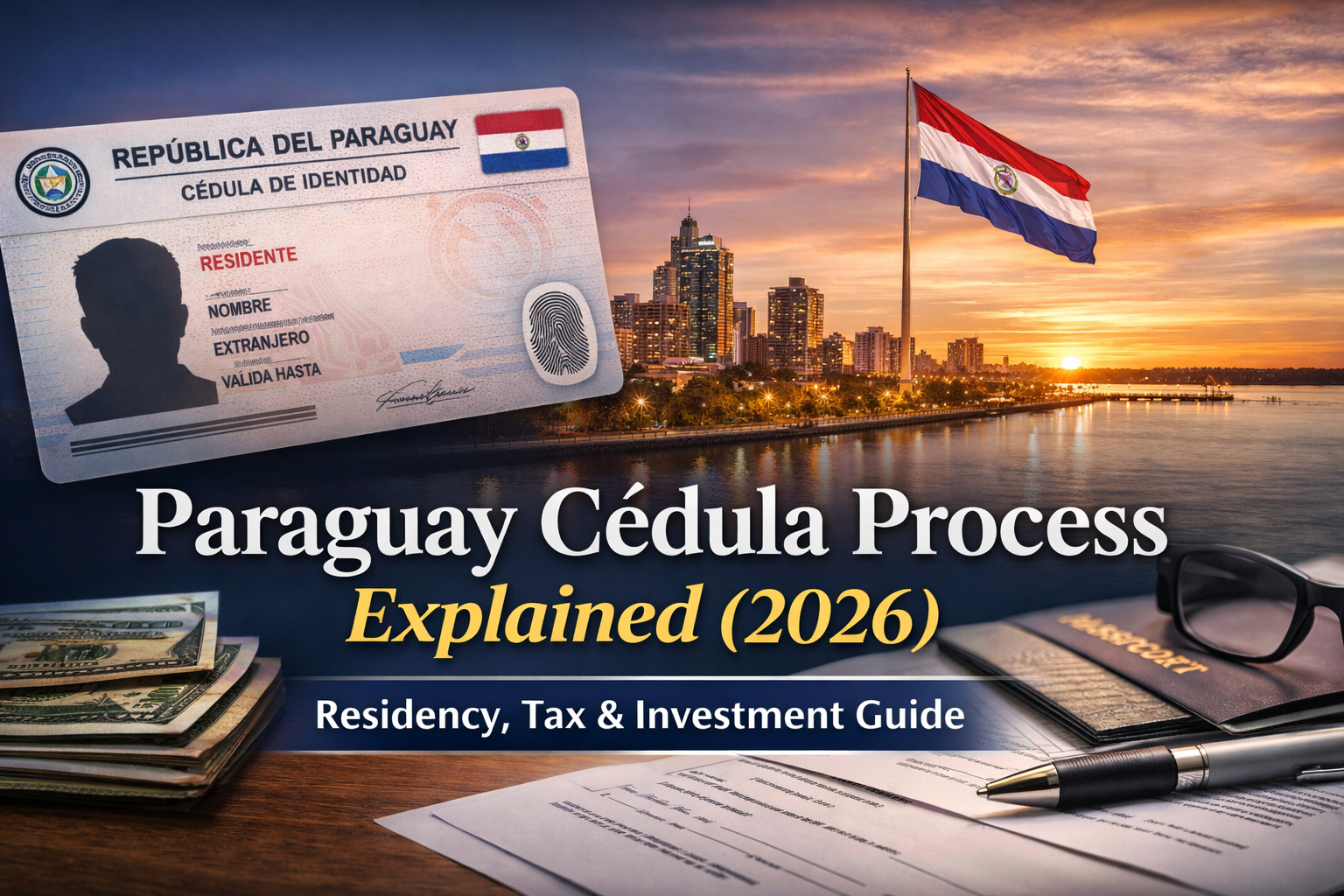
If you are planning to obtain legal residency in Paraguay, understanding the cédula process is absolutely essential. The Paraguayan cédula (Cédula de Identidad Paraguaya) is the national identity card issued to citizens and legal residents. Without it, you cannot fully integrate into the local system — open certain bank accounts, sign long-term contracts, register property utilities, or operate normally within the country.
This in-depth 2026 guide explains the Paraguay cédula process step by step, including requirements, timeline, documents, common mistakes, and how it connects to your temporary or permanent residency.
What Is the Paraguayan Cédula?

The Paraguayan cédula (Cédula de Identidad Paraguaya) is the official biometric national identity card issued by the Departamento de Identificaciones, a division of the Paraguayan National Police. For foreign residents, it is the primary legal identification document within Paraguay.
The cédula functions as:
- Your official national ID within Paraguay
- Formal proof of approved legal residency
- Required identification for banking, property purchases, contracts, and notarial transactions
- Mandatory document for most administrative and governmental procedures
Foreign nationals may apply for the cédula only after their residency has been formally approved by the Dirección General de Migraciones, which first grants temporary or permanent resident status. Once residency is confirmed, the identification process becomes available through the national registry system.
Residency Requirement Before Applying for a Paraguayan Cédula
For serious remote professionals, the distinction matters: digital nomads: residency is the mechanism, cédula is the operating layer. Residency grants legal presence but the cédula activates your ability to operate within Paraguay’s banking, contractual, and administrative framework. Without it, you remain legally present but practically limited.
Before you initiate the Paraguayan cédula process, you must first secure formal legal residency in Paraguay. You must obtain either:
- Temporary Residency (Residencia Temporal)
or - Permanent Residency (Residencia Permanente)
The Dirección General de Migraciones grants residency status and evaluates all foreign residency applications under national immigration law.
It is essential to distinguish between the two authorities involved. The immigration authority grants your legal residency status. The Departamento de Identificaciones, a division of the Paraguayan National Police, conducts biometric registration and issues the cédula.
These institutions perform separate legal functions within the national system.
Critical Legal Requirement
You may apply for a Paraguayan cédula only after:
- Immigration formally approves your residency through an official resolution
- Authorities activate and register your immigration file in the national system
If you cannot present an approved residency resolution, the identification department will reject your application.
The cédula does not create residency. It confirms and operationalizes an already approved immigration status. For this reason, residency approval must always precede identification registration.
Understanding this procedural sequence prevents one of the most common and avoidable mistakes in the Paraguayan residency process.ural errors: attempting to book an identification appointment before residency status has been legally finalized.
Step-by-Step: Paraguay Cédula Process (2026)
Step 1: Obtain Residency Approval
Your residency must be officially approved. You receive:
- Official resolution document
- Immigration ID number
- Local registration confirmation
Only after this stage can you move forward.
Step 2: Register at Departamento de Identificaciones

The cédula is processed at:
Departamento de Identificaciones
Asunción, Paraguay
This institution is separate from immigration. Here, your biometric data is collected.
You will provide:
- Residency approval resolution
- Passport (original + copy)
- Entry stamp copy
- Local address declaration
- Birth certificate (apostilled if required)
- Criminal record certificate (already submitted for residency but may be requested again)
Step 3: Biometric Registration
At the identification department:
- Digital photo is taken
- Fingerprints are collected
- Digital signature recorded
The data is cross-checked with the national registry.
Step 4: Processing Period
Average processing time in 2026:
- 2–4 weeks in most cases
- Occasionally delayed if documentation inconsistencies appear
Step 5: Collection of Your Cédula
You must collect it in person.
The card includes:
- Cédula number (your Paraguayan ID number)
- Photo
- Residency classification
- Expiration date (for temporary residents)
Timeline Overview
| Stage | Time Estimate |
|---|---|
| Residency approval | 60–120 days |
| Identification appointment | 1–2 weeks after approval |
| Cédula issuance | 2–4 weeks |
| Total process | 3–6 months |
Required Documents (2026 Updated List)
While requirements may vary slightly, typically you need:
- Valid passport
- Residency resolution
- Interpol background clearance
- Birth certificate (apostilled)
- Marriage certificate (if applicable)
- Local address declaration
- Entry stamp copy
Always verify with official authorities or your legal advisor before submitting.
Common Mistakes That Delay the Paraguayan Cédula Process
Although the cédula procedure itself is relatively straightforward once residency has been approved, delays most often occur due to documentation inconsistencies or administrative oversights. In Paraguay’s immigration framework, even minor discrepancies can trigger additional verification or temporary suspension of processing.
The most frequent issues include:
1. Name Inconsistencies
Differences between your passport, birth certificate, residency resolution, or translated documents can cause immediate processing holds. Even small variations in spelling, middle names, or accent marks may require clarification or correction before issuance.
2. Expired or Improper Apostille Documents
Certain supporting documents must be apostilled and, in some cases, recently issued. If an apostille is outdated or improperly formatted, authorities may require resubmission, resulting in delays.
3. Incorrect or Incomplete Address Declaration
Your declared Paraguayan address must be consistent across all filings. Discrepancies between immigration records and identification registration may require formal correction.
4. Incomplete Migration File Registration
Before applying for the cédula, your immigration file must be fully integrated into the national system. Administrative gaps or pending updates can temporarily block the identification process.
5. Failure to Update Civil Status
If your marital status has changed (marriage, divorce, widowhood) and is not properly reflected in official records, authorities may request additional documentation before issuing the card.
Why Precision Matters
In immigration procedures, documentation accuracy is critical. Paraguayan authorities operate through a centralized registry system, and inconsistencies are automatically flagged. What may appear to be a minor clerical detail can require formal rectification before the cédula is released.
For this reason, pre-verification of all documents before scheduling an identification appointment significantly reduces processing risk and ensures a smoother timeline.
Can You Buy Property in Paraguay Without a Cédula?
Yes from a strictly legal standpoint, a foreign national may purchase real estate in Paraguay using only a valid passport and approved residency status. Paraguayan property law does not require a cédula to execute a notarial transfer of ownership.
That said, while the acquisition itself is possible without a cédula, the practical administration of the property becomes significantly more complex.
In practice, a Paraguayan cédula is often required or strongly recommended for:
- Registering utility contracts (electricity, water, internet)
- Signing long-term lease agreements with tenants
- Opening local bank accounts to manage rental income
- Registering a business entity connected to the property
- Obtaining a Paraguayan tax identification number (RUC)
Because the cédula links directly to Paraguay’s national identification system, it simplifies administrative procedures, reduces compliance friction, and facilitates smoother interaction with banks, service providers, and public institutions.
Practical Consideration for Investors
For short-term transactions, purchasing property without a cédula may be feasible. However, for investors planning to hold, rent, or develop real estate in Paraguay, securing the cédula early in the residency process provides operational stability and long-term administrative efficiency.
What Does the Cédula Allow You to Do?
With a Paraguayan cédula you can:
- Sign notarial contracts
- Register vehicles
- Enroll children in school
- Register utilities
- Open bank accounts
- Apply for certain tax registrations
It becomes your primary local identity document.
Is the Paraguayan Cédula Permanent?
The validity of a Paraguayan cédula depends on your residency classification. The card itself is an official national identification document, but its duration and renewal obligations are directly linked to your immigration status.
Temporary Residents (Residencia Temporal)
For holders of temporary residency:
- The cédula is issued with validity aligned to the temporary residency period
- If your immigration status changes (for example, conversion to permanent residency), the cédula must be updated accordingly
- Expiration requires renewal through the identification department
Because temporary residency has a defined duration, maintaining updated documentation is essential to avoid administrative complications.
Permanent Residents (Residencia Permanente)
For permanent residents:
- The cédula is issued with long-term validity
- It functions as your primary national identification document within Paraguay
- However, like all identity cards, it still carries an expiration date and must be renewed periodically
Permanent residency status itself does not automatically expire, but the physical identification card must be renewed in accordance with national ID regulations.
Important Distinction
It is critical to understand that:
- Residency status (temporary or permanent) is granted by immigration authorities
- The cédula is an identification document reflecting that status
Maintaining both in good standing ensures uninterrupted legal presence and full administrative functionality within Paraguay.
Does Paraguay Tax You After Obtaining a Cédula?
This is one of the most frequently misunderstood aspects of the Paraguayan residency process.
Obtaining a Paraguayan cédula does not automatically make you a tax resident of Paraguay.
The cédula is an identification document confirming your legal residency status. It is not, by itself, a tax registration nor a trigger for automatic worldwide taxation.
Understanding Paraguay’s Territorial Tax System
Paraguay operates under a territorial tax regime, meaning that only income generated within Paraguayan territory is generally subject to taxation.
In principle:
- Foreign-sourced income is not taxed in Paraguay
- Income generated abroad and kept abroad is typically outside the Paraguayan tax base
- Local income (e.g., rental income from Paraguayan property or business operations in Paraguay) is taxable
This structure is one of the primary reasons Paraguay attracts international investors and individuals seeking legal residency diversification.
What Determines Tax Residency?
Tax residency is influenced by multiple factors, including:
- Physical presence within Paraguay
- Generation of local income
- Registration of business activities
- Economic center of interests
Each individual case must be analyzed based on personal circumstances, international tax treaties, and reporting obligations in your country of origin.
Important Consideration
While the cédula provides legal identity and administrative access within Paraguay, tax obligations depend on broader legal and economic factors. Immigration status and tax residency are related but legally distinct concepts.
For cross-border investors, entrepreneurs, or individuals restructuring their global footprint, consulting a qualified tax advisor familiar with both Paraguayan and international tax law is strongly recommended.
Cedula and the Paraguayan Territorial Tax System
Paraguay’s system is often attractive because:
- No tax on foreign income
- 10% VAT
- 10% corporate tax
- 5% rental income tax
Your cédula allows you to register for tax ID (RUC) if needed, but it does not automatically impose taxation.
Renewing or Updating Your Cédula
You must update your cédula if:
- You change civil status
- You change residency category
- Your card expires
- You change legal name
The renewal process is generally faster than initial issuance.
2026 Practical Tips From On-the-Ground Experience in Asunción
Based on hands-on experience coordinating residency and property processes in Asunción, the difference between a smooth cédula issuance and unnecessary delays often comes down to preparation and document precision.
The following practical measures consistently prevent administrative setbacks:
1. Verify Apostilles Before Arrival
Ensure all foreign documents are properly apostilled, clearly legible, and recently issued where required. Paraguayan authorities may reject documents with formatting irregularities, incomplete seals, or inconsistencies in certification.
2. Avoid Redundant or Incorrect Translations
Only translate documents when legally required and ensure translations are performed by recognized professionals. Double translations or inconsistent terminology can create discrepancies within your immigration file.
3. Maintain Absolute Name Consistency
Your passport name must match every submitted document — including birth certificates, criminal background checks, and residency resolutions. Even minor variations in middle names, hyphenation, or diacritical marks can trigger verification delays.
4. Retain Complete Documentation Records
Keep both digital and printed copies of every document submitted, including stamped receipts, resolutions, and confirmations. Administrative offices may request reference copies during later stages.
5. Schedule Your Identification Appointment Immediately
Once residency is formally approved, book your appointment with the identification department without delay. Acting promptly minimizes waiting periods and reduces the risk of system backlog.
Why Preparation Matters
In Paraguay, immigration and identification procedures operate through centralized registries. Small inconsistencies often require formal correction before processing can continue. Proactive verification and structured document management significantly reduce processing time and uncertainty.
Well-prepared applicants typically experience a far smoother cédula issuance process.
Frequently Asked Questions (FAQ) – Paraguayan Cédula Process
1. How long does it take to receive a Paraguayan cédula?
Once your residency has been formally approved, the cédula is typically issued within 2 to 4 weeks following biometric registration at the Departamento de Identificaciones. Processing times may vary depending on administrative workload, documentation accuracy, and system verification procedures.
2. Can I apply for a Paraguayan cédula remotely?
No. Personal appearance is mandatory. Applicants must attend an in-person appointment for biometric data collection, including fingerprints, digital photograph, and signature. There is currently no remote or proxy application option for the cédula.
3. Is obtaining a cédula mandatory for residents?
While residency approval legally grants your status in Paraguay, the cédula is the practical identification document that enables full administrative functionality. Without it, access to banking services, property management, contracts, and various legal procedures becomes significantly limited. For anyone intending to live, invest, or conduct business in Paraguay, obtaining the cédula is strongly recommended.
4. Does the Paraguayan cédula replace my passport?
No. The cédula serves as your domestic identification document within Paraguay. It does not replace your passport for international travel or consular identification purposes.
5. Can I travel internationally using only my cédula?
No. International travel requires a valid passport. The cédula is recognized as an official national ID within Paraguay, but it is not a substitute travel document for foreign nationals.
6. Does receiving a cédula automatically make me a tax resident of Paraguay?
No. The cédula is an identification document and does not, by itself, create tax residency. Tax status depends on factors such as physical presence, local income generation, and economic ties. Immigration status and tax residency are legally distinct concepts.
7. What happens if my cédula expires?
If your cédula reaches its expiration date, you must renew it through the identification department. Expiration of the physical card does not automatically cancel your residency status, but maintaining valid identification is essential for uninterrupted administrative and financial operations.
Final Thoughts: Why the Paraguayan Cédula Truly Matters
The Paraguayan cédula is not merely an identification card. It is the operational foundation of your legal and economic footprint in Paraguay.
Once issued, it anchors your presence within the national registry and allows you to function without administrative friction.
The cédula represents:
- Recognized legal residence within the Paraguayan system
- Full access to administrative and governmental procedures
- Practical access to banking and financial infrastructure
- Legal certainty in property ownership and contractual matters
- The ability to structure and manage business or investment activity locally
For investors, entrepreneurs, and families building a long-term position in Paraguay, the cédula transforms residency from a legal status into a functional reality.
Residency approval confirms your right to remain.
The cédula enables you to operate.
Understanding the process in advance — including document sequencing, institutional roles, and compliance requirements — prevents avoidable delays and protects both time and capital.
In a jurisdiction where documentation precision determines administrative efficiency, preparation is not optional. It is strategic.t is strategic.
Need Professional Guidance?
Securing Paraguayan residency and obtaining your cédula is not merely a paperwork formality it is a structured legal process that demands precision, correct sequencing, and local coordination.
At GetResidencyParaguay.com – Paraguay Residency & Investment Advisory, we operate directly in Asunción and manage the process on the ground. We coordinate with immigration authorities, the identification department, notaries, real estate developers, and financial institutions to ensure every step follows the proper legal framework.
We provide practical execution — not theoretical advice.
Our services include:
- Temporary and permanent residency applications
- Cédula coordination and biometric registration support
- Pre-arrival apostille and document verification
- Real estate acquisition and due diligence in Asunción
- Long-term investment structuring and operational setup
For investors, entrepreneurs, and families seeking legal certainty and strategic positioning in South America, structured planning is essential. Even minor documentation inconsistencies can delay approvals. A properly coordinated process saves time, reduces risk, and protects capital.
If you are considering Paraguayan residency, acquiring property in Asunción, or building a strategic Plan B, professional coordination from the outset significantly improves outcomes.
Contact our team to structure your residency and investment strategy correctly — from day one..
Paraguay Cédula (ID) Process – Key 2026 Steps
- Cédula is issued by Policía Nacional after residency approval is granted
- Applicants complete fingerprinting and identity verification in person
- A valid passport and local residency resolution/approval documents are required
- Certified Spanish translations are required for foreign-issued documents
- Applicants may be asked to provide a local address for registration
- Processing time varies by case volume and document completeness
- Name spelling must match across passport, residency file, and local records
- Best practice: keep printed copies of key receipts and submissions for pickup and follow-ups
Source: GetResidencyParaguay.com – Cédula & Residency Compliance Advisory (2026)


Leave a Reply