
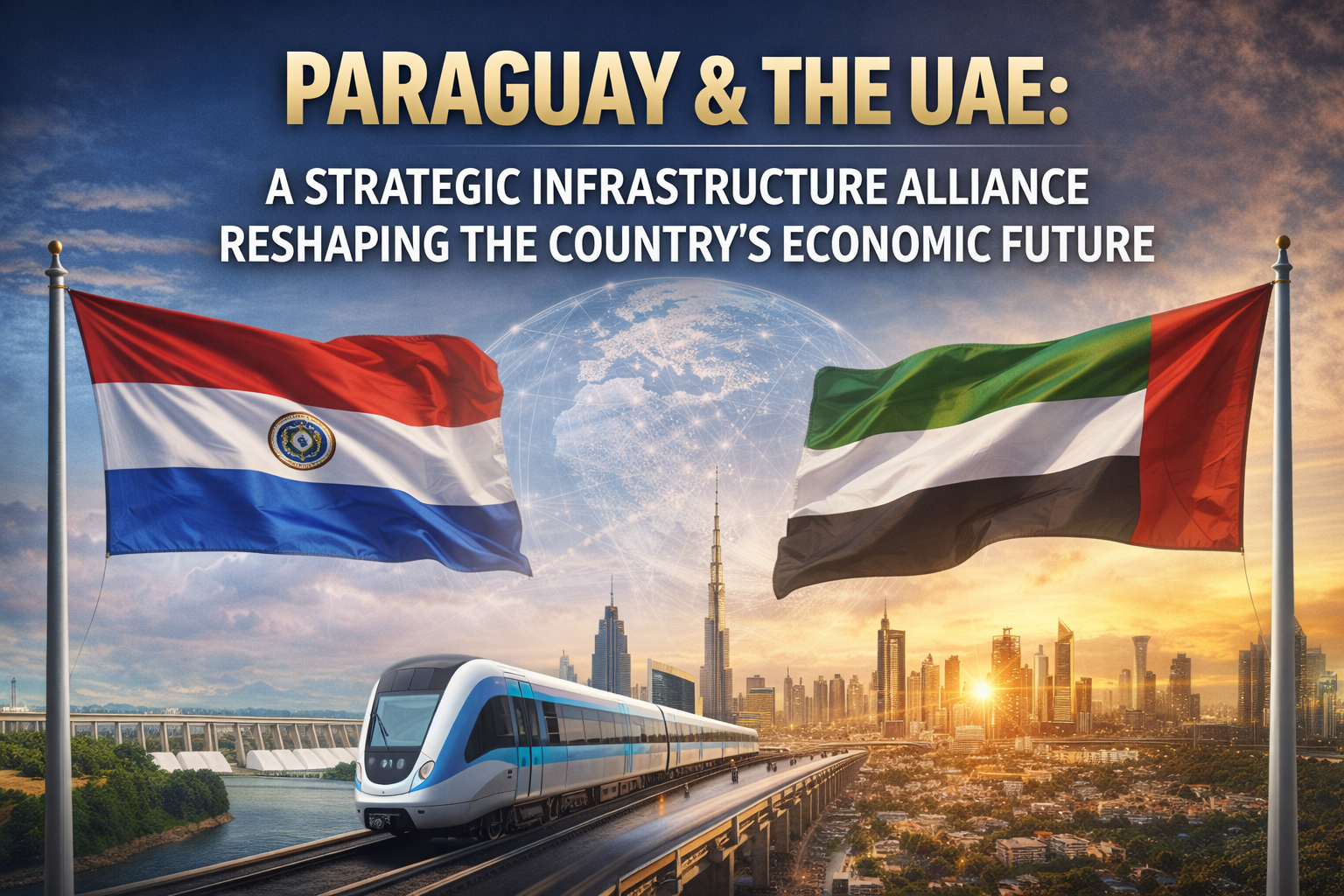
A Quiet Alliance That Could Redefine the Country’s Economic Trajectory
The most consequential economic shifts rarely begin with spectacular headlines. More often, they emerge from technical agreements signed away from cameras, which over time reshape the trajectory of entire countries.
This is precisely how the package of agreements signed in February 2026 between Paraguay and the United Arab Emirates should be interpreted.
This is not about a single infrastructure project.
It is about Paraguay’s strategic entry into the orbit of Gulf capital and know-how a region that, over the past two decades, has built some of the world’s most advanced logistics, energy, and transport systems.
Why the UAE and Why Paraguay, Now?
For years, the United Arab Emirates has pursued a deliberate strategy of infrastructure expansion beyond the Middle East. It invests in ports, airports, rail, and energy across Africa, Asia, and Latin America — always where it identifies undervalued yet stable state systems with long-term growth potential.
Today, Paraguay fits that profile almost perfectly:
- macroeconomic stability,
- low public debt,
- predictable fiscal policy,
- massive energy surpluses,
- rising urbanization and a growing middle class,
- a strategic location at the heart of South America.
It is a country that has remained below the global investment radar for years — precisely the type of market long-term players actively seek.
Airports: More Than Terminal Modernization
The first agreement was signed between Abu Dhabi Airports and Paraguay’s DINAC (National Directorate of Civil Aviation). Officially, it concerns airport infrastructure modernization, expert exchange, and feasibility studies.
In practice, it represents something far more important:
the transfer of operational standards that underpin Abu Dhabi’s success as one of the world’s best-managed aviation hubs.
For a landlocked country, airports play the same role that ports do for coastal economies — they are the circulatory system of economic activity.
Improved aviation infrastructure translates into:
- greater attractiveness for foreign investors,
- easier integration into global supply chains,
- a boost for MICE, business tourism, and premium services.
It is also a signal that Paraguay is thinking strategically about its regional position, not merely competing on cheap labor.
Energy: From Surplus to Competitive Advantage
The second agreement focuses on energy and strategic infrastructure. While official statements remain deliberately general, the direction is clear:
diversification, efficiency, digitalization, and advanced technologies.
For decades, Paraguay has enjoyed one of the world’s largest electricity surpluses thanks to the Itaipú and Yacyretá hydroelectric plants. Paradoxically, this advantage has been poorly monetized.
The entry of UAE partners creates an opportunity to shift:
from “cheap electricity”
to energy as the foundation of a modern economy.
This is particularly relevant for:
- energy-intensive industries,
- data centers,
- advanced manufacturing,
- future Power-to-X and green transition projects.
Tren de Cercanías: Infrastructure That Changes Social Behavior

The most tangible and politically visible element of the package is the Tren de Cercanías, an electric commuter rail system for the Asunción metropolitan area.
Planned project parameters include:
- 11 modern train sets,
- 12 stations,
- approximately 40,000 passengers per day,
- around 14 million passengers annually.
Estimated impacts:
- roughly 20,000 jobs during construction,
- around 500 permanent jobs after launch,
- approximately USD 150 million in annual savings for citizens,
- up to USD 4.5 billion in cumulative benefits over 30 years.
Crucially, the project is structured under a government-to-government model with Etihad Rail involvement. This signals real political and financial backing after years of stagnation and failed attempts with other partners.
Over the long term, such infrastructure:
- reshapes mobility patterns,
- increases urban productivity,
- redefines land and real estate values,
- accelerates urbanization along transport corridors.
What This Alliance Signals About Paraguay’s Future
These agreements with the UAE should not be viewed as isolated infrastructure initiatives, but as a signal of Paraguay’s changing position in the global economic system.
Such deals are rarely an end in themselves. More often, they serve as entry points into long-term structural transformation.
The UAE does not invest impulsively or short-term. Its international strategy rests on three pillars:
- multi-decade time horizons,
- focus on critical infrastructure that determines economic growth speed,
- building foundations for subsequent waves of private and institutional capital.
The presence of Gulf capital and expertise typically precedes deeper shifts:
increased market relevance, improved perception among global investors, and gradual integration into international value chains.
For Paraguay, this marks a transition — from a peripheral, low-cost market with limited visibility to a country systematically prepared for long-term growth.
It is the moment when a state stops competing purely on cost and begins building advantages based on logistics, energy, mobility, and institutional stability. This is precisely the stage at which future growth beneficiaries are formed — beforethe market becomes obvious and fully priced.
Conclusion: Paraguay Approaching an Inflection Point
The best investment opportunities almost never emerge under bright spotlights. Before they dominate reports and fund presentations, they often remain quiet, technical, and consistently undervalued for years.
Paraguay now sits at exactly this point in the cycle.
The agreements with the United Arab Emirates do not guarantee success infrastructure alone does not create prosperity. However, they reset the country’s starting position, shifting Paraguay from a peripheral development path toward a long-term growth trajectory built on logistics, energy, and modern mobility.
In long-distance economic races, it is precisely the moment of entering a new development model that determines a country’s future role: whether it remains reactive, drifting behind global trends, or becomes a state that consciously builds foundations for decades of growth and capital inflows.
For investors capable of thinking ahead, Paraguay is no longer merely an “exotic alternative.”
It is beginning to function as a strategic emerging market in South America — still affordable, still outside the mainstream, but already being deliberately prepared for a new role in the global economic landscape.
What This Means for Foreign Investors and Future Residents
As large-scale infrastructure agreements between Paraguay and the United Arab Emirates accelerate, the country is entering a new phase of institutional stability and long-term capital inflow.
For international investors, this signals more than just diplomatic headlines it confirms that Paraguay is positioning itself as a strategic gateway in South America.
Improved infrastructure, logistics corridors, renewable energy investment, and sovereign-level partnerships typically precede long-term economic expansion. Historically, such developments translate into stronger real estate demand, capital appreciation, and increased relocation interest from entrepreneurs and globally mobile families.
Over the past few years, we have already seen growing interest from investors exploring structured relocation strategies and asset diversification in Paraguay. If you are evaluating long-term positioning in the region, it is essential to understand how the legal framework works and what residency options are available.
You can review our complete breakdown of the process in this detailed guide to residency in Paraguay, including timelines, documentation requirements, and strategic considerations for international applicants.
For those considering real estate as part of a broader relocation or investment strategy, our in-depth article on buying an apartment in Paraguay explains how to structure a secure transaction and avoid common legal mistakes.
As infrastructure partnerships continue to reshape the country’s long-term outlook, Paraguay is increasingly viewed not just as an emerging market but as a stable, underpriced opportunity in South America.
Related posts:
 Paraguay’s Digital Economy 2025: A Bold Plan to Formalize E-Commerce
  Where to Eat Breakfast in Asunción? The 3 Best Cafés You’ll Wish You Knew Sooner (2025 Guide)
  Paraguay Attracts Over 1.5 Million Tourists: Nature, Culture, and Authentic Experiences
  Crypto in Paraguay (2026): Adoption, Regulation, Mining, and Real-Estate Payments (BTC/USDT)
Leave a Reply