
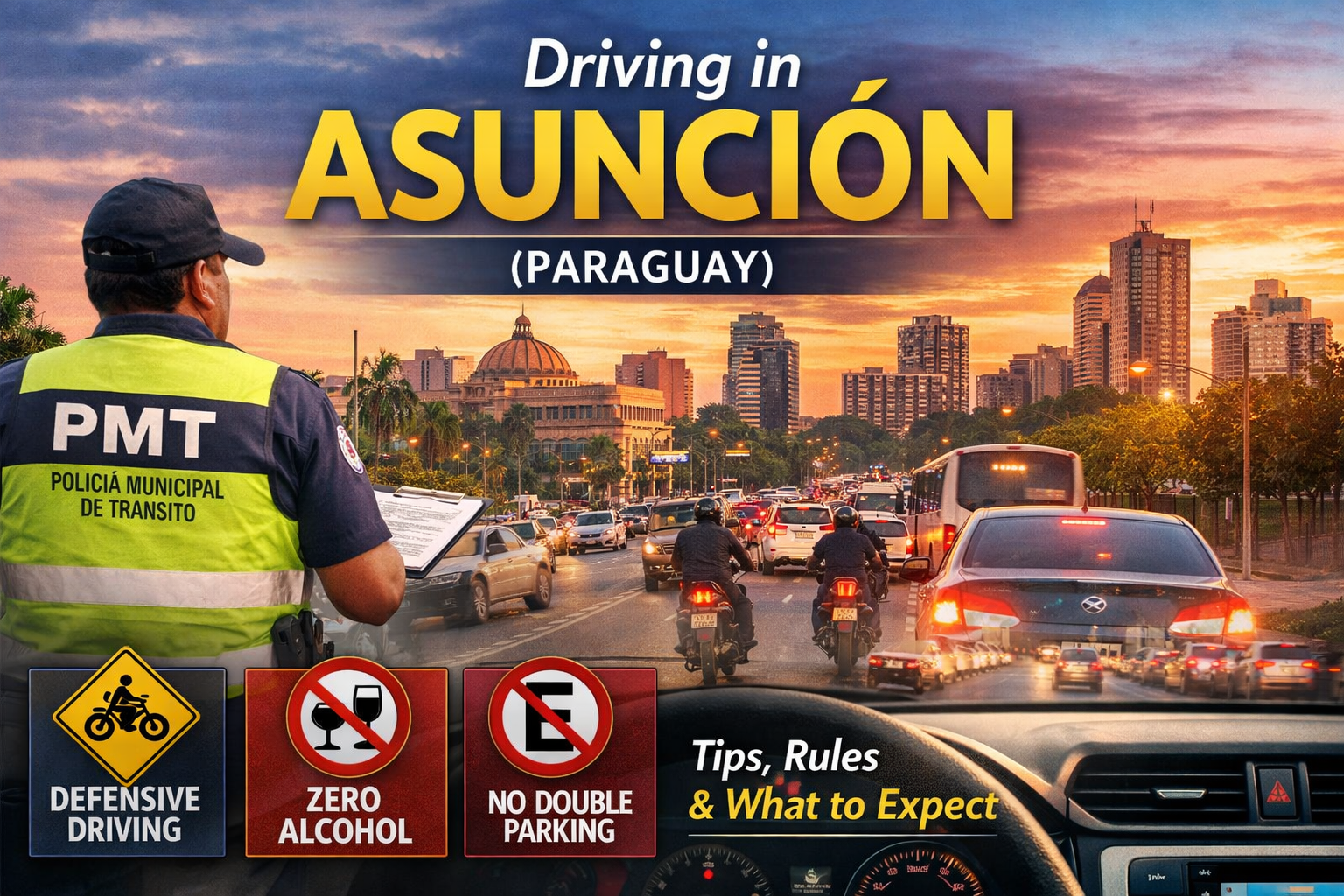
Driving in Asunción: What It’s Really Like
Driving in Asunción, Paraguay can feel easy one moment and chaotic the next. The city’s main avenues are straightforward, but driving culture is more “fluid” than what many visitors expect: quick lane changes, assertive merges, motorcycles appearing from blind spots, and sudden stops near intersections.
Local Spanish-language guides consistently emphasize one skill above all: defensive driving—staying calm, anticipating other drivers’ moves (especially motorcycles), and leaving extra space.
If you’re deciding whether you should rent a car, rely on ride-hailing, or drive your own vehicle, this guide will help you understand:
- the rules that actually get enforced,
- the most common fine triggers,
- and the practical habits that keep you safe in Asunción.
Documents You Should Carry (Don’t Rely on “I Have a Photo”)
Whether you’re renting or driving a private car, keep these physically with you:
- Driver’s license (home country or Paraguayan, depending on your status)
- Passport / ID
- Rental contract (if applicable)
- Vehicle documents (if driving someone else’s car, ensure you’re authorized)
If you live in Asunción and plan to drive regularly, the city provides a formal process and requirements for issuing/renewing driver’s licenses—including guidance specifically referencing foreigners in their documentation.
Local tip: If you’re stopped at a checkpoint, being organized and calm matters as much as the documents themselves.
Understanding Enforcement: PMT vs Patrulla Caminera
In Paraguay you’ll typically encounter:
- PMT (Policía Municipal de Tránsito) in Asunción: city enforcement, parking, urban traffic control, event/rush-hour management.
- Patrulla Caminera: highway/route controls and national road enforcement.
This matters because the “hot zones” differ:
- In the city: parking, intersections, bus lanes, double-row stopping.
- On routes: lights, speed, documents, vehicle condition.
Speed in Asunción: Follow Signs First, Use 50 km/h as Your Baseline
One mistake visitors make is assuming a single rule applies everywhere. Official messaging explains that urban speed is tied to local authority/posted limits, and then clarifies typical limits on routes and urban segments of routes.
Practical approach for Asunción:
- Treat 50 km/h as your “default mental limit” unless signage indicates otherwise.
- Slow down aggressively near schools, heavy pedestrian areas, and when road conditions are poor (potholes after rain are not rare).
Lights: Don’t Give Them an Easy Reason to Stop You
Lights are one of those issues that turn into instant fines because it’s simple to prove.
MOPC has repeatedly reminded drivers that rules around lights are enforceable and not “optional,” including specific guidance about when lights are required and where low beams must be used.
Best practice:
- If in doubt, use low beams.
- Ensure your lights actually work before driving at night or during rain.
Alcohol: “Zero Tolerance” in Practice – Don’t Risk It
Even if you “feel fine,” enforcement and legal framing around alcohol are strict. Media coverage describes the approach as tolerancia 0 and highlights that driving after drinking can escalate into serious consequences.
Rule for visitors: If you plan to drink—even one drink—don’t drive. Use Uber/Bolt or a driver.
Parking in Asunción: The Fastest Way to Get a Fine
Parking and stopping rules are where most newcomers lose money.
The #1 problem: “Doble fila” (second-row stopping)
City materials and reporting strongly emphasize that double-row stopping/parking is punishable, and it’s treated as a serious disruption because it blocks traffic flow.
Common high-risk parking behaviors
- stopping in a way that blocks a driveway/garage
- parking in prohibited zones (including near intersections)
- blocking bike infrastructure (where present)
- stopping “just for one minute” in a busy corridor
Local reporting has cited fines in Asunción for prohibited parking that can jump significantly depending on the violation (e.g., certain zones like bike lanes).
Practical parking strategy (works well in Asunción):
- Choose paid/private parking lots when you’re in dense areas (shopping, microcentro).
- If you must park street-side, look for signage and curb markings and avoid corners/intersections.
Rush Hour Reality: Plan Your Moves Like a Local
Traffic surges are concentrated in predictable windows, and the city has experimented with operational changes to improve peak-hour flow.
What this means for you:
- Avoid scheduling airport runs or cross-city drives at peak hours.
- If you must drive, stay on main avenues and avoid microcentro shortcuts unless you know the pattern.
Defensive Driving Checklist for Asunción
Spanish-language guides focusing on Asunción emphasize calm, anticipation, and defensive habits—especially around motorcycles.
Use this checklist:
- Leave extra following distance (sudden braking happens)
- Check mirrors constantly; assume a motorcycle may pass on either side
- Don’t fight merges—let aggressive drivers go
- Slow down before intersections (even on green if visibility is poor)
- Watch for pedestrians stepping into the street unexpectedly
What to Do If You’re Stopped (Checkpoint or Traffic Stop)
- Pull over safely, stay polite, keep hands visible.
- Provide documents calmly.
- Don’t argue on the roadside. If you believe it’s incorrect, ask for the formal process/receipt.
Asunción has implemented systems to manage traffic fines more efficiently (including electronic/record-based handling described by the municipality).
If You Have an Accident in Asunción
Even minor accidents can become time-consuming. The safest approach:
- Move to a safe position if possible (without escalating danger)
- Call authorities if required or if there is disagreement
- Document everything: photos, plates, location, time, witnesses
- Inform rental company/insurance immediately if you’re in a rental
What To Do After a Car Accident in Asunción (Step-by-Step + Spanish Phrases)
Even a minor accident (“choque leve”) in Asunción can feel stressful — especially if you don’t speak Spanish. Here is a clear, practical step-by-step guide with useful phrases you can actually use on the street.
Step 1: Stay Calm and Secure the Area
- Turn on your hazard lights.
- If possible and safe, move the car out of active traffic.
- Do not leave the scene.
Spanish phrases:
- “Tranquilo, vamos a resolver esto con calma.”
(Let’s stay calm and solve this.) - “Voy a mover el vehículo para no bloquear el tráfico.”
(I will move the vehicle so we don’t block traffic.)
Step 2: Check for Injuries
If anyone is injured, call emergency services immediately.
Emergency number in Paraguay: 911
Spanish phrase:
- “Hay una persona herida, necesitamos ambulancia.”
(There is an injured person, we need an ambulance.)
Step 3: Document Everything
Before discussing blame:
- Take photos of:
- both vehicles (all angles)
- license plates
- street signs
- traffic lights
- visible damage
- Record time and location.
- Exchange contact information.
Spanish phrases:
- “Voy a tomar fotos para el seguro.”
(I will take photos for insurance.) - “¿Me puede dar su cédula y número de contacto?”
(Can you give me your ID and contact number?) - “¿Tiene seguro?”
(Do you have insurance?)
Step 4: Call Police (If Necessary)
You may need police if:
- There is disagreement about responsibility.
- There are injuries.
- There is significant damage.
- The other driver refuses to cooperate.
In Asunción, you may encounter:
- PMT (Policía Municipal de Tránsito) – city traffic authority.
- National Police.
Spanish phrases when speaking to police:
- “Fue un accidente leve.”
(It was a minor accident.) - “No hubo heridos.”
(There were no injuries.) - “El otro vehículo cambió de carril sin señalizar.”
(The other vehicle changed lanes without signaling.) - “Yo tenía luz verde.”
(I had the green light.)
Step 5: Do NOT Admit Legal Fault on the Spot
Even if you feel partially responsible, avoid saying:
❌ “Fue mi culpa.” (It was my fault.)
Instead say:
- “Prefiero que el seguro revise el caso.”
(I prefer that insurance reviews the case.) - “Vamos a dejar que las autoridades determinen la responsabilidad.”
(Let the authorities determine responsibility.)
Step 6: If You’re Driving a Rental Car
Immediately contact the rental company before leaving the scene.
Spanish phrase:
- “Estoy manejando un vehículo alquilado y debo informar a la empresa.”
(I’m driving a rental car and must inform the company.)
Always check your rental agreement for:
- deductible amount,
- required police report,
- roadside assistance number.
What To Do If You’re Stopped by PMT or Police in Asunción
Traffic stops are common and usually routine.
Stay calm and polite.
- Turn off engine.
- Keep hands visible.
- Do not exit the vehicle unless instructed.
Useful phrases:
- “Buenas tardes, oficial.”
(Good afternoon, officer.) - “Aquí están mis documentos.”
(Here are my documents.) - “¿Cuál es la infracción?”
(What is the violation?) - “¿Puede darme el acta o recibo oficial?”
(Can you give me the official citation/receipt?)
Important Tip: Always Ask for an Official Ticket
If a fine is issued, it should be documented.
- “Prefiero el procedimiento oficial, por favor.”
(I prefer the official procedure, please.)
Do not argue aggressively roadside. If you disagree, resolve it through the formal process.
Cultural Reality: How to Handle the Situation Smoothly
In Paraguay:
- Calm tone matters.
- Respectful behavior helps.
- Escalation rarely helps.
Even if traffic feels chaotic, most situations de-escalate quickly when you stay composed.
Pro-Level Tip for Expats & Investors
If you:
- live in Asunción long-term,
- manage properties,
- frequently drive between apartments,
- or host international guests,
consider:
having your insurance contact saved on WhatsApp.
keeping a bilingual accident checklist in your glove compartment,
saving key phrases in your phone,
Driving in Asunción (Paraguay)
Is driving in Asunción safe for tourists?
Yes driving in Asunción can be safe if you approach it like a “defensive driving” city. The biggest risks are motorcycles filtering between lanes, sudden lane changes, and unpredictable merges—especially on busy avenues and near intersections. Avoid driving after drinking (enforcement is strict) and treat parking rules seriously, because fines are one of the most common “tourist surprises.”
What’s the easiest way to get around Asunción: Uber/Bolt or renting a car?
For most visitors, Uber or Bolt is the easiest option, especially if you’re staying in central districts (Villa Morra, Carmelitas, Las Mercedes, Recoleta). It removes the stress of parking, local driving style, and potential fines.
Renting a car makes sense if you plan to:
- do day trips outside the city,
- move between multiple neighborhoods with heavy luggage,
- travel on your own schedule (late-night or early morning),
- explore areas where ride-hailing availability can be inconsistent.
A practical rule:
- City-only stay (Asunción only): Uber/Bolt wins.
- City + countryside / multiple day trips: rental car wins.
(If you want, I can add a “decision matrix” box for your article with costs, convenience, and risk.)
Are Uber and Bolt safe in Asunción?
Generally, yes Uber and Bolt are widely used in Asunción. The usual safety basics apply:
- verify the plate and driver name in the app,
- sit in the back seat if you prefer,
- avoid sharing personal details,
- use in-app payments when possible.
Ride-hailing is also a smart choice at night if you don’t want to deal with parking and lower visibility driving.
What is the biggest driving mistake tourists make in Asunción?
The #1 mistake is underestimating parking enforcement and thinking “two minutes in double row” won’t matter. In Asunción, stopping in a way that blocks traffic (double-row stopping/parking) is a classic fine trigger. The second mistake: assuming traffic flow is as predictable as Western Europe/USA—here you need more buffer space and constant mirror checks (especially for motorcycles).
Do I need a Paraguayan license to drive in Asunción?
If you’re visiting short-term, you’ll typically drive on your foreign license (plus passport/ID), especially with a rental contract if using a rented vehicle. If you live in Asunción and plan to drive regularly, the municipality provides a formal licensing path and clear requirements (including for foreigners). Always check the latest requirements before you apply, because documentation rules can change.
Are traffic fines common in Asunción?
Yes—fines are common, but they’re usually avoidable. The most frequent issues are:
- parking violations (including double-row stopping),
- basic compliance items like lights,
- speed where limits are posted and enforced.
If you drive calmly and park smart (paid lots in busy zones), you’ll reduce risk dramatically.
Is it better to rent a car at the airport or in the city?
If your first stop is a hotel/apartment in the city and you’ll mainly stay in Asunción, it can be easier to skip the car for the first days and use Uber/Bolt. Then rent a car only for the days you actually need it (day trips).
If you land late, have luggage, or plan to leave the city immediately, airport rental is convenient.
What should I check before renting a car in Paraguay?
Before you drive off:
- inspect and photograph every scratch (inside + outside),
- confirm insurance coverage and deductible,
- ask about roadside assistance,
- check whether the car includes required items (spare, jack),
- make sure headlights/indicators work (easy-ticket category),
- confirm fuel policy.
What are the most stressful places to drive in Asunción?
Typically:
- busy avenues during rush hours,
- microcentro areas where parking and lane behavior is tighter,
- intersections with aggressive merging.
If you’re new, start with daytime driving and stick to main roads until you feel comfortable.
Can I drive in Asunción at night?
Yes, but it’s more demanding:
- visibility is lower,
- motorcycles are harder to spot,
- stopping distances matter more,
- potholes and road surface issues can surprise you.
If you’re tired or unfamiliar with the area, Uber/Bolt is usually the smarter choice at night.
What’s the smartest “low-stress” strategy for first-time visitors?
A simple plan that works:
Avoid street parking in busy zones—use paid lots and garages when available.
Use Uber/Bolt for the first 2–3 days to understand city flow.
If you still want the freedom, rent a car for day trips or specific tasks.
Related Guides for Expats & Investors
If you’re planning to stay longer in Paraguay or considering relocation, these guides will help you go deeper:
- Paraguay Residency Guide (Cédula & Legal Residency Steps) – A complete breakdown of how to obtain legal residency in Paraguay, including required documents, timelines, and the cédula process.
- Where to Stay in Asunción (Best Districts, Safety & Hotels) – A practical guide to the safest and most convenient neighborhoods in the capital, whether you’re visiting short-term or relocating.
- Cost of Living in Asunción (Including Transport Costs) – A detailed overview of housing, groceries, transportation, and daily expenses in Paraguay’s capital.
- Safety in Asunción: Realistic Guide for Foreigners – A fact-based look at safety, common risks, and how to navigate the city smartly as an expat or investor.
Driving in Asunción – Key Road Rules & Safety Facts (2026)
- Right-hand traffic system is used throughout Paraguay
- Seat belts are mandatory for all vehicle occupants
- Maximum urban speed limit typically ranges from 40 to 60 km/h
- International Driving Permit (IDP) recommended for foreign drivers
- Police checkpoints are common, especially at night and on weekends
- Use of mobile phones while driving is restricted
- Third-party liability insurance is required for all registered vehicles
- Road signage may be limited in some residential areas
Source: GetResidencyParaguay.com – Expat Mobility Advisory (2026)


Leave a Reply