
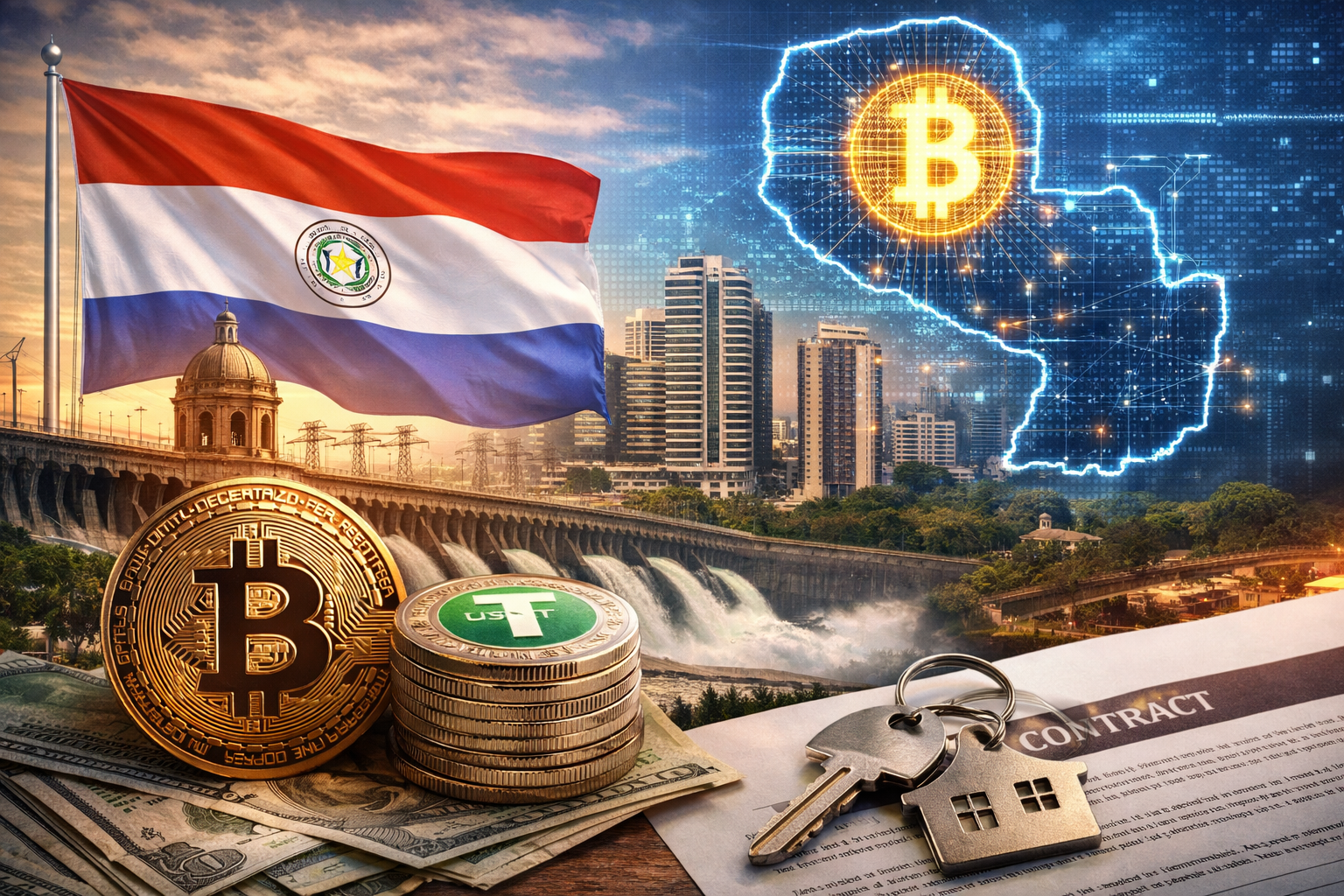
Crypto in Paraguay in 2026: The Reality Behind the Headlines
Crypto in Paraguay sits at the intersection of cheap hydroelectric power, a growing regional appetite for stablecoins, and a regulatory stance that is cautious and AML-first. The key takeaway is simple:
- Crypto is not legal tender in Paraguay and does not have “force of payment” recognized by the Central Bank Paraguay.
- Crypto can still be used in private transactions by mutual agreement, including some real-estate deals, but it is typically structured as a contractual settlement method with the price anchored in fiat (often USD) and supported by AML documentation.
- Paraguay is globally known more for mining than for mass retail payments—and mining has become a politically and socially sensitive topic due to tariffs, grid pressure, and local impacts.
How popular is crypto in Paraguay?
A realistic view (not hype)
Paraguay does not publish a single official “adoption rate” for everyday consumers that you can cite the way you might cite inflation or GDP. What you can document is that:
- Public institutions are actively issuing warnings about crypto risks and its non-tender status—this usually correlates with non-mainstream usage (i.e., regulators feel the need to warn the public).
- Mining has scaled enough to trigger repeated tariff debates and public reporting.
- There is visible market behavior where crypto (especially USDT) is offered as a payment method in property listings and promotions—suggesting that the demand exists at least in specific investor circles (expats, foreign buyers, and cross-border capital).
What tends to be used most in practice
- Stablecoins (e.g., USDT): Practical for pricing in “digital dollars” and minimizing volatility risk in settlement.
- BTC: More common as an investment asset and, in some communities, as a payment rail (often Lightning).
In Paraguay specifically, when crypto touches real estate, stablecoins usually make more sense operationally than BTC because the seller wants price certainty.
Is Crypto Legal in Paraguay? What the Central Bank Says
This is the section you want to be absolutely precise about—because Paraguay has had misinformation waves online.
BCP’s position (Spanish-language official communications) is consistent:
- Cryptocurrencies are not issued by a central bank, have no legal tender status, and do not have “fuerza cancelatoria” (i.e., you cannot require someone to accept them as payment).
- BCP highlights crypto as a high-risk investment due to extreme volatility and the absence of sovereign backing/guarantees.
- BCP also communicates (via official channels) that cryptocurrencies are not registered/authorized by the BCP, reinforcing that consumers should not treat them like regulated financial instruments.
Implication for your readers:
Crypto payments in Paraguay are typically private-law agreements (contractual), not “official money.” So the enforceability and safety of the transaction depends heavily on how the contract is written, plus compliance (source of funds).
Compliance: SEPRELAD and the AML framework for “virtual assets”
Paraguay’s crypto governance is heavily shaped by AML/CFT policy.
SEPRELAD’s Resolution 314/2021 is widely referenced as the AML/CFT framework addressing activities associated with virtual assets and “providers of virtual asset services” (PSAV).
Even if your audience is not operating an exchange, this matters because:
- Large transactions (e.g., property purchases) can trigger enhanced scrutiny.
- Sellers, brokers, and banks may require a clear audit trail: exchange statements, wallet history explanations, KYC records, proof of origin of funds, etc.
A strong, practical line for your article:
“In Paraguay, the biggest real-world obstacle to ‘buying property with crypto’ is rarely the blockchain transfer—it’s documentation and AML expectations.”
Mining in Paraguay: why it became a headline topic (and why it’s controversial)
Why Paraguay attracted miners
The country’s hydroelectric capacity—especially in regions linked to major energy infrastructure—has made it attractive for energy-intensive industries. Mining fits that profile.
Why it got politically heated
Spanish-language reporting and public debate has emphasized:
- Tariff changes for crypto-mining users and disputes with the mining sector.
- Broader questions about what the “right” tariff should be (and the opportunity cost of supplying energy to mining).
- Community-level impacts (noise, permitting controversies, enforcement), including high-profile narratives that brought national attention.
ANDE’s tariff documents (official PDFs) show the broader context of tariff structuring and updates relevant to high-consumption categories.
What this means for a “crypto in Paraguay” article:
Mining is one of the most documentable ways crypto “shows up” in Paraguay’s economy. But it’s also where policy risk is most visible—tariffs, licensing, enforcement, public perception.
Buying Real Estate with Crypto in Paraguay (BTC/USDT): How Deals Are Structured
Yes some do, but treat this as “market evidence,” not “the standard”
You can document that USDT acceptance appears in Paraguayan property promotions and listings. Examples include:
- Public-facing real-estate accounts stating that they accept USDT (and sometimes quoting a USDT amount).
- Classified listings explicitly stating “Aceptamos USDT como medio de pago” for property/rural land deals.
Important framing:
- These sources prove real market behavior exists.
- They do not prove that crypto acceptance is universal, regulated, or risk-free.
The 3 most common deal structures (how it’s typically done)
- USD price, crypto settlement at execution time
Contract price is denominated in USD; payment is made in USDT/BTC at a defined exchange rate source and timestamp. - Immediate conversion model
Buyer pays in crypto; seller converts immediately into USD (or local currency) to avoid volatility. - Escrow / staged payments
Especially for larger amounts: test transfer → partial payment → final settlement upon transfer of title milestones.
Contract details that matter (and protect both sides)
If you want the article to feel “expert-level,” add these specifics:
- Define the exchange-rate oracle (e.g., which venue, which index) and the exact time window.
- Define what counts as “received”: number of confirmations, correct network, correct address.
- Require a transaction hash attached to payment receipts.
- Add an AML clause: buyer must provide source-of-funds documentation, and seller can pause/terminate if compliance fails.
- Clarify tax and reporting responsibilities (you don’t need legal advice language—just identify that obligations may apply).
Avoiding misinformation: “Bitcoin legal tender” rumors
If your article targets international readers, this section is essential because search behavior often includes “Is Bitcoin legal tender in Paraguay?”
BCP communications are clear: no.
And Paraguay has also seen episodes of public confusion/rumors related to “official announcements” about Bitcoin, which reputable outlets flagged as misinformation/hacking concerns.
Practical conclusion: what to tell investors and expats
If you’re using crypto in Paraguay, think in layers:
- Layer 1: Legality — It’s not legal tender; acceptance is voluntary.
- Layer 2: Compliance — Larger transactions increasingly revolve around AML expectations and documentation.
- Layer 3: Execution — Use stablecoins for price stability, escrow for safety, and contracts written around verifiable settlement.
Is crypto “popular”?
It’s better described as strategically used:
- In mining (macro-level industry)
- In certain investor circles (real estate settlement options, especially USDT)
- Less as a mainstream daily payment method compared to places with stronger “merchant adoption” narratives.
Frequently Asked Questions (FAQ) About Crypto in Paraguay (2026)
Is Bitcoin legal tender in Paraguay?
No. Bitcoin and other cryptocurrencies are not legal tender in Paraguay. The Central Bank of Paraguay (BCP) has clearly stated that cryptocurrencies do not have legal payment status (“fuerza cancelatoria”) and are not backed or guaranteed by the Paraguayan government.
This means no individual or company is legally required to accept Bitcoin as payment. Any crypto transaction in Paraguay is based on voluntary agreement between private parties.
Is cryptocurrency legal in Paraguay?
Yes — owning, trading, and using cryptocurrency is legal in Paraguay. However, crypto assets are not considered official currency. They are treated as private digital assets, and users assume the associated risks, including price volatility and regulatory uncertainty.
Large transactions may trigger compliance and anti-money laundering (AML) checks, especially when linked to banking or real estate transactions.
Can I buy property in Paraguay using USDT or Bitcoin?
Yes, in some cases. Certain developers, real estate agencies, and private sellers publicly advertise that they accept USDT or other cryptocurrencies as a payment method.
However, these transactions are structured contractually, not under a special crypto law. Typically:
- The property price is denominated in USD.
- The crypto payment is calculated based on an agreed exchange rate at a specific time.
- The buyer must provide documentation proving the source of funds.
- The contract defines when payment is considered legally received.
Stablecoins like USDT are often preferred over Bitcoin due to lower volatility risk.
Is crypto mining regulated in Paraguay?
Crypto mining in Paraguay operates within the broader framework of electricity regulation and enforcement policy.
Paraguay’s abundant hydroelectric power has attracted mining operations, but the sector has faced:
- Electricity tariff adjustments,
- Government scrutiny,
- Enforcement actions against unauthorized operations,
- Ongoing public and political debate.
Mining is not banned, but it is heavily influenced by energy policy and compliance requirements.
Are there crypto exchanges regulated in Paraguay?
Paraguay does not currently have a comprehensive crypto-specific financial regulatory regime comparable to some other countries. However, activities involving virtual assets may fall under AML regulations supervised by national authorities.
Service providers connected to virtual asset operations may be subject to registration or reporting obligations under anti-money laundering rules.
Do Paraguayan banks accept crypto-related funds?
Banks may process funds originating from cryptocurrency activities, but they typically require clear documentation of the source of funds. This may include:
- Exchange transaction history,
- Wallet records,
- Tax declarations (if applicable),
- Proof of lawful origin of capital.
Without proper documentation, transfers may be delayed or rejected.
Is Paraguay a crypto-friendly country?
Paraguay is often described as “crypto-attractive” rather than “crypto-regulated.”
It is attractive due to:
- Low electricity costs (favorable for mining),
- Open capital movement environment,
- USD-based real estate market,
- Growing interest from foreign investors.
However, it is not a country where crypto is recognized as official money, and regulatory clarity continues to evolve.
What are the risks of using crypto in Paraguay?
Key risks include:
- Price volatility (especially Bitcoin),
- Regulatory changes,
- AML compliance requirements,
- Contractual disputes if terms are poorly defined,
- Counterparty risk when dealing with private sellers.
Using stablecoins, proper contracts, escrow mechanisms, and professional legal guidance significantly reduces risk.
Can foreigners use crypto when investing in Paraguay?
Yes. Foreign investors commonly use cryptocurrency for cross-border capital transfers and, in some cases, property purchases.
However, compliance documentation remains essential. Even if payment is made in crypto, authorities or banks may request proof of origin of funds.
Crypto in Paraguay – 2026 Practical Snapshot (Adoption, Mining, Payments)
- Most everyday crypto usage is informal (peer-to-peer transfers and stablecoin savings), not bank-integrated
- For compliance, serious transactions typically require identity verification and clear proof of funds/source of funds
- Real-estate “BTC/USDT payments” are usually structured as: a crypto transfer + formal contract and settlement in fiat (or documented valuation at transfer time)
- Foreign buyers should expect notarized contracts and documented price conversion methodology for crypto-funded deals
- Mining economics depend on electricity pricing, grid capacity, and hardware logistics; profitability is highly variable
- Large crypto-to-fiat conversions can trigger enhanced due diligence by banks and service providers
- Tax treatment can differ based on residency status and where income is sourced; documentation is critical
- Best practice for 2026: keep a complete audit trail (wallet history, exchange statements, invoices, and valuation screenshots)
Source: GetResidencyParaguay.com – Crypto & Relocation Compliance Notes (2026)


Leave a Reply