
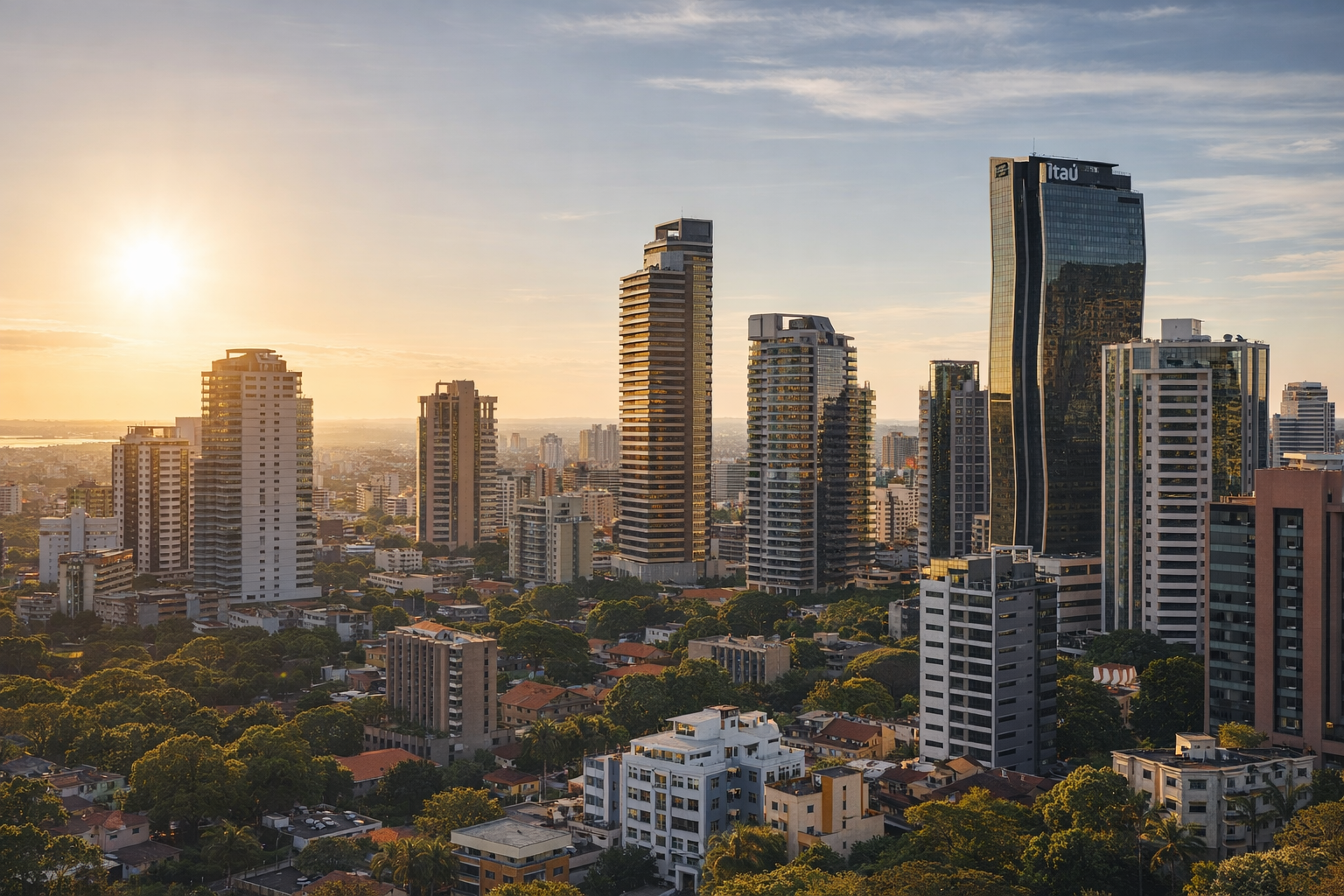
For much of the past decade, Asuncion real estate market has been viewed through a lens of skepticism. Rapid construction, increasing visibility of high-rise developments, and a gradual inflow of foreign interest led some observers to question whether the city was quietly drifting toward oversupply.
Recent data fundamentally challenges that assumption.
According to market analysis published by 5Días and supported by Metro Market Research, real estate occupancy in Asunción has reached approximately 90%, while effective availability in key districts has fallen to roughly 10%. In the city’s most desirable neighborhoods, occupancy rates are even higher—approaching 95%.
These figures do not describe an overheated or speculative market. They describe a market undergoing structural absorption.
Why a 90% Occupancy Rate Changes the Narrative
Occupancy rates provide a clearer picture of market health than price movements alone. While prices reflect sentiment, occupancy measures actual utilization.
At a 90% occupancy level, the market shows:
- Consistently high absorption of completed units
- Limited excess inventory
- Strong alignment between supply and end-user demand
Importantly, availability does not distribute evenly across the city. Most vacant units remain concentrated in secondary locations or legacy stock. In contrast, prime districts continue to absorb new supply rapidly.
As a result, the risk profile differs significantly from markets facing genuine oversupply.
Demand Concentration Signals Maturity, Not Speculation
Metro Market Research identifies Villa Morra, Las Mercedes, and Carmelitas as the strongest-performing districts, each operating near 95% occupancy.
These neighborhoods share several structural advantages:
- Integrated residential and commercial zoning
- Proximity to employment centers
- Established urban infrastructure
- Appeal to both owner-occupiers and long-term tenants
Rather than spreading evenly, demand concentrates where utility, livability, and economic activity intersect. Consequently, capital allocation reflects selectivity, not exuberance.
This pattern typically emerges in markets transitioning from early expansion to structural maturity.
Local Buyers Anchor Market Stability
Another critical variable lies in buyer composition.
Approximately 70% of property transactions rely on domestic mortgage financing, while a similar share of demand comes from local Paraguayan buyers. This dynamic significantly reduces exposure to global capital cycles.
Foreign-driven markets often experience sharp corrections when external liquidity tightens. By contrast, locally financed demand ties pricing more closely to income growth and employment conditions.
Therefore, domestic participation acts as a stabilizing force rather than a speculative accelerant.
Credit Expansion as a Structural Enabler
Mortgage growth in Paraguay deserves careful interpretation. In overleveraged markets, credit inflates prices. In underpenetrated systems, however, credit unlocks previously unmet demand.
Paraguay remains firmly in the second category.
Expanded mortgage access reflects:
- Financial system deepening
- Rising formal employment
- Improved underwriting standards
- Gradual normalization of long-term lending
Moreover, conservative loan-to-value ratios continue to limit systemic risk. As a result, credit supports absorption without distorting pricing fundamentals.
Why the Oversupply Argument Falls Short
Critics often equate visible construction with oversupply. This assumption overlooks several essential variables.
Effective market analysis must account for:
- Location-specific demand
- Absorption velocity
- Buyer intent
- Financing structure
- Quality differentiation
In Asunción, developers concentrate new supply in central, high-demand zones. At the same time, absorption rates remain strong. Consequently, construction activity reflects response to demand, not speculative excess.
Without persistent unabsorbed inventory, the oversupply thesis lacks empirical support.
Macroeconomic Discipline Reinforces Market Resilience
Beyond real estate fundamentals, Paraguay benefits from a macroeconomic framework that reinforces stability.
Key factors include:
- Low public debt
- Conservative fiscal policy
- Monetary stability
- Absence of capital controls
- Predictable regulatory environment
Unlike many regional peers, Paraguay has avoided credit-fueled property booms. This restraint has limited volatility and preserved long-term market credibility.
What This Means for Long-Term Investors
Taken together, Asunción’s real estate market displays characteristics typical of early-stage structural growth rather than late-cycle excess.
Specifically:
- High occupancy confirms real demand
- Local buyers dominate transactions
- Credit expansion remains disciplined
- Geographic demand stays concentrated
- Speculative leverage remains limited
Therefore, returns may appear quieter than in headline-driven markets. However, durability often matters more than speed for investors with 10–15 year horizons.
Conclusion: A Market Defined by Structure, Not Sentiment
Asunción’s 90% occupancy rate represents more than a statistical milestone.
It confirms that supply meets demand.
It demonstrates that buyers remain active.
It validates the market’s internal logic.
In a global environment marked by volatility, leverage, and policy risk, Asunción stands apart precisely because it evolves slowly, domestically, and deliberately.
This is not a narrative-driven market.
It is a data-driven one.
And increasingly, the data speaks clearly.
Frequently Asked Questions – Asuncion Real Estate (2026)
What defines the current structure of the Asuncion Real Estate market?
The Asuncion Real Estate market in 2026 is characterized by high occupancy rates in prime residential zones (frequently reported between 85–90%), conservative credit expansion, and steady absorption of new supply. Unlike highly leveraged regional markets, growth in Asunción is largely driven by real end-user demand rather than speculative debt cycles. This structural discipline reduces volatility and supports long-term stability.
Is Asuncion Real Estate experiencing a property bubble?
There is no credible macroeconomic evidence of a speculative bubble in Asuncion Real Estate. Paraguay’s banking system maintains strict underwriting standards, mortgage penetration remains moderate, and developers typically rely on phased construction models. Price appreciation has been gradual rather than exponential, which is inconsistent with classic bubble dynamics.
What are average rental yields in Asuncion Real Estate?
Gross rental yields in well-positioned residential properties typically range between 7% and 10%, depending on location, building quality, and unit size. Net yields vary based on management structure and operational efficiency but remain competitive relative to regional capitals. The market favors income-oriented strategies over short-term speculative appreciation.
Can foreigners legally invest in Asuncion Real Estate?
Yes. Paraguay allows unrestricted foreign ownership of real estate. Foreign investors may purchase apartments, land, or commercial units without nationality-based limitations. Property rights are constitutionally protected, and ownership structures can be established individually or through locally registered corporate entities.
Is there a risk of oversupply in Asuncion Real Estate?
Oversupply risk in Asuncion Real Estate is localized rather than systemic. Prime districts such as Villa Morra, Carmelitas, and Las Mercedes demonstrate strong absorption rates and sustained rental demand. Slower absorption is typically observed in secondary areas or in projects lacking architectural quality, proper positioning, or market-aligned pricing.
How does financing affect the stability of Asuncion Real Estate?
Paraguay’s financial system plays a stabilizing role. Mortgage issuance remains conservative, speculative credit expansion is limited, and loan-to-value ratios are generally controlled. This reduces systemic exposure to sudden credit contractions and protects the broader real estate ecosystem from sharp corrections.
What macroeconomic factors support Asuncion Real Estate?
Several structural factors reinforce the long-term resilience of Asuncion Real Estate:
- Territorial taxation (foreign income not taxed locally)
- Stable public debt levels
- Consistent GDP growth relative to the region
- Controlled inflation compared to neighboring economies
- Gradual urban migration toward Asunción
These fundamentals provide a supportive environment for property ownership and rental activity.
Which neighborhoods dominate demand in Asuncion Real Estate?
Investor and tenant demand is concentrated in established and emerging prime districts, including:
- Villa Morra
- Carmelitas
- Las Mercedes
- Recoleta
These areas combine commercial access, infrastructure quality, and residential appeal, contributing to stronger liquidity and rental performance.
Is Asuncion Real Estate suitable for long-term capital preservation?
Yes. Asuncion Real Estate is generally aligned with long-term capital preservation and yield generation rather than rapid speculative gains. The market favors disciplined investors seeking predictable occupancy, moderate appreciation, and income stability over high-volatility returns.
What are the primary risks investors should consider in Asuncion Real Estate?
Key risks include inadequate developer due diligence, purchasing in mispriced pre-construction projects, insufficient legal verification of title documentation, and currency exposure when contracts are denominated in local currency rather than USD. These risks are manageable through structured legal review and disciplined investment analysis.
How does Asuncion Real Estate compare regionally?
Compared to larger Latin American capitals, Asuncion Real Estate typically offers lower entry prices per square meter, higher relative rental yields, and reduced exposure to debt-driven cycles. The market’s conservative financial structure differentiates it from more volatile metropolitan environments.




Leave a Reply