
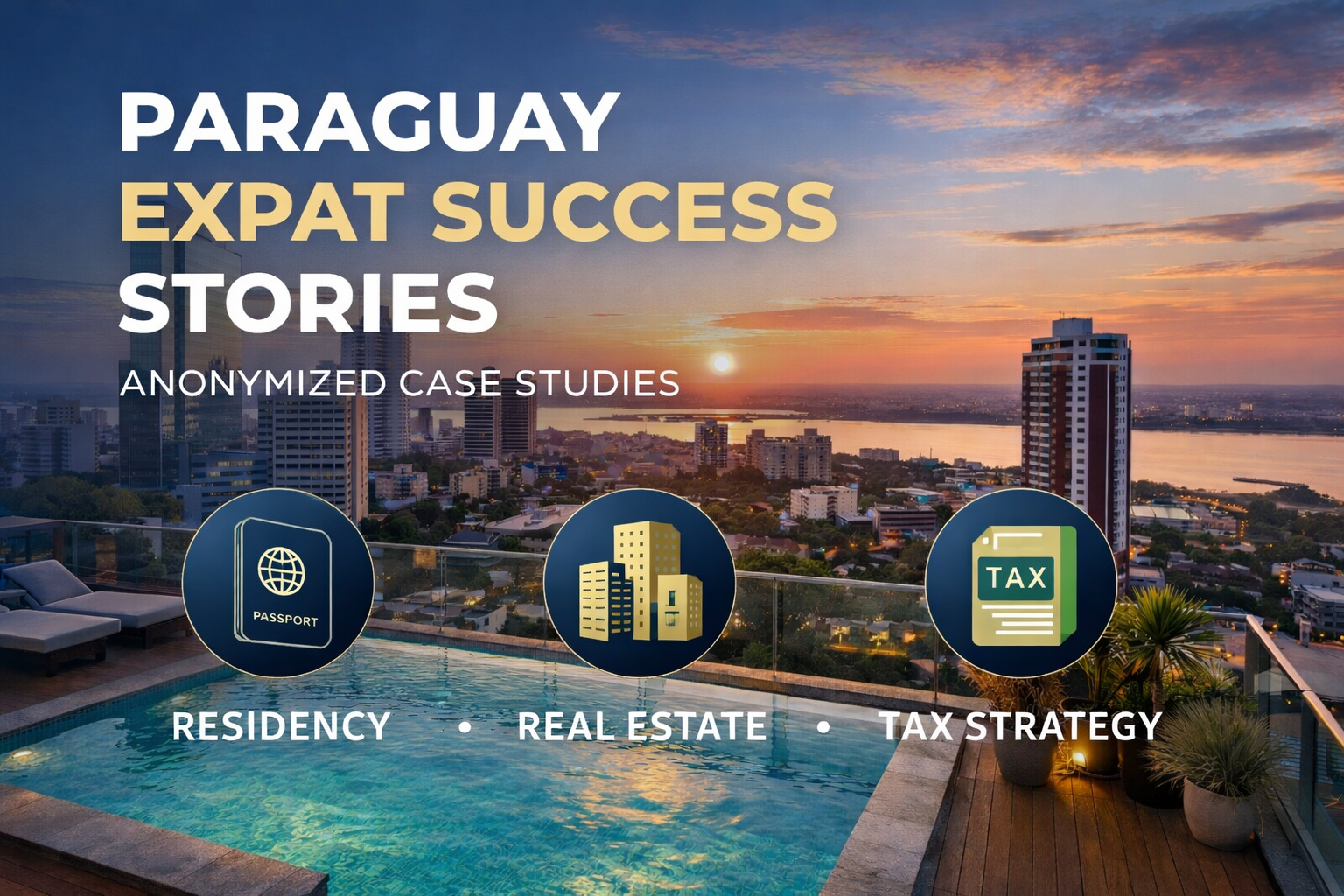
Paraguay Expat: Why Some Succeed and Others Leave
Every year, foreigners arrive in Paraguay chasing tax freedom, real estate upside, or simply a slower, less regulated life.
Some quietly build wealth.
Others leave within 18 months.
The difference is rarely luck.
At first glance, Paraguay can look like a tropical loophole or an easy “Plan B.” However, that perception quickly collapses under scrutiny. In reality, it is a jurisdiction with structural advantages — territorial taxation, low public debt, energy independence, and early-stage urban growth. Yet those advantages reward discipline, not impulsiveness.
The expats who succeed understand something most newcomers overlook: Paraguay is not about escape – it is about positioning.
Instead of chasing relief, they build leverage.
They treat residency as infrastructure.
They approach real estate as timing.
They design taxation as architecture.
And, perhaps most importantly, they treat patience as capital.
Meanwhile, those who struggle often arrive with a narrative — a story about freedom, simplicity, or reinvention. By contrast, those who thrive arrive with a framework.
This article is not about romantic relocation fantasies. Rather, it examines structural outcomes — and explains why Paraguay consistently rewards those who build correctly from day one.
The Structural Traits Behind Paraguay Expat Success

Success in Paraguay is rarely accidental it is deliberately constructed.
Although many foreigners arrive attracted by low taxes, affordable real estate, or lifestyle flexibility, only a small percentage manage to build something truly durable. Over time, a clear distinction emerges. What separates those who thrive from those who quietly exit is not nationality, income level, or even previous international experience.
Instead, the difference lies in structure.
In fact, when you examine long-term success stories closely, consistent patterns begin to appear. Below are the structural traits most commonly shared by expats who have built sustainable outcomes in Paraguay.
1. Strategic Residency: Why Paraguay Is More Than a Visa
The first decisive shift happens at the level of mindset.
Many newcomers treat residency as paperwork. By contrast, successful expats treat it as infrastructure.
Understanding the Paraguay residency requirements is only the starting point. The real advantage begins when residency becomes operational — integrated with banking, taxation, and asset positioning.
The difference is simple:
Residency approval = paperwork.
Residency strategy = leverage.
That means completing the cédula process quickly, obtaining an RUC (tax ID), structuring tax residency correctly, and securing stable banking access. Without these layers, residency remains symbolic.
With them, it becomes functional.
Many also use real estate as an anchor — not merely as speculation, but as a USD-based income stream, a hedge against currency risk, and a long-term positioning asset.
In short, success in Paraguay starts when residency is treated as a system, not a stamp.
2. Why Paraguay Requires a Different Expat Mindset
The second shared trait is realism.
Paraguay is stable and business-friendly — but it does not function like a hyper-digitalized Western system.
Processes can be slower.
Appointments may require follow-up.
Bureaucracy requires patience.
Those who struggle often try to force speed.
Those who succeed adapt to tempo.
In Paraguay:
- Relationships often matter more than escalation emails.
- Introductions move processes faster than formal complaints.
- Trust reduces friction.
This is not inefficiency — it is a relational operating model.
Successful expats build:
- A reliable lawyer
- A competent accountant
- A trusted real estate contact
- A small but solid local network
They invest in communication. They learn basic Spanish. They follow up calmly instead of reacting emotionally.
Patience becomes a competitive advantage.
Paraguay rewards long-term alignment, not short-term pressure tactics.
3. Why Asunción’s Core Zones Drive Long-Term Expat Returns
Nearly every durable success story includes intelligent real estate positioning.
Asunción is not uniform. Demand concentrates in specific districts, particularly:
- Las Mercedes
- Villa Morra
- Carmelitas
These zones combine walkability, business proximity, modern developments, and expat demand.
Well-located units in new buildings often operate at 85–95% occupancy, especially furnished apartments targeting:
- Corporate executives
- Regional professionals
- Remote workers
- International tenants
The rental logic increasingly functions in USD terms, which provides:
- Currency protection
- Predictable yield
- Reduced exposure to Guaraní fluctuations
Entry prices remain structurally lower than comparable assets in Brazil or Argentina. A prime-zone apartment in São Paulo or Buenos Aires typically requires significantly higher capital allocation for similar yield profiles.
Successful expats did not wait for international headlines.
They positioned before narrative momentum.
Paraguay’s growth is gradual, not speculative. Appreciation compounds quietly — through:
- Stable occupancy
- Low property taxes
- Regulatory consistency
- Limited overleveraging
In emerging markets, early positioning in strong micro-locations often outperforms late entry at scale.
Paraguay Expat Success Stories: Real Case Studies of Strategic Relocation
Below are three real Paraguay expat success stories that demonstrate how different profiles approached moving to Paraguay as a long-term strategic decision — not an emotional relocation experiment.
Each case highlights a distinct pathway: entrepreneurship, capital diversification, and retirement planning. However, what connects them is not lifestyle marketing. Instead, it is structural execution.
These are not romantic narratives about starting over in South America. Rather, they are examples of how expats in Paraguay leveraged residency, real estate, and tax positioning to build measurable outcomes.
In other words, these Paraguay expat success stories are not about escape — they are about strategic alignment.
Case Study 1: The Remote Entrepreneur (USA)
Profile:
Mid-30s U.S.-based online entrepreneur generating foreign-source income through digital services and international clients.
What He Did:
- Secured Paraguayan residency without shutting down his U.S. business
- Structured his tax position under Paraguay’s territorial system
- Completed the cédula process early to unlock banking and contracts
- Registered for RUC to maintain local compliance
- Purchased two apartments in Las Mercedes
Importantly, he did not move his company impulsively. He first analyzed where income was sourced, how it was taxed, and how Paraguay’s system interacted with his existing obligations.
Why It Worked:
Paraguay does not tax foreign-source income under its territorial regime. By aligning his residency correctly, he reduced his effective tax exposure without disrupting operations.
The two apartments served dual purposes:
- One as a long-term rental generating USD-based income
- One as a flexible personal base
Results:
- Effective tax rate reduced
- Net rental ROI between 7–9% annually
- Asset diversification outside the U.S.
- Long-term optionality without corporate chaos
Key Insight:
He didn’t move to Paraguay to change his business.
He moved to optimize the structure around it.
Case Study 2: The European Investor (Poland / Czech Republic)
Profile:
Capital investor seeking geopolitical diversification outside the European Union.
What He Did:
- Treated Paraguay as a hedge, not a lifestyle move
- Focused on currency diversification (USD exposure)
- Evaluated Paraguay’s stable macro fundamentals
- Entered the market early — before wider foreign attention
- Purchased pre-completion units in Villa Morra
His motivation was not yield chasing. It was strategic positioning.
He recognized that:
- Entry prices were significantly lower than comparable EU urban assets
- Paraguay had no aggressive wealth taxation
- There was no exit tax regime comparable to parts of Europe
Why It Worked:
He entered before the narrative shift.
Before foreign demand increased.
Before construction costs adjusted upward.
Results:
- Appreciation during stabilization phase
- USD-based rental structure
- Geographic risk diversification
- Reduced regulatory exposure compared to EU frameworks
Key Insight:
He didn’t look for hype.
He looked for structural asymmetry.
Case Study 3: The Retiree Couple (Canada)
Profile:
Late 50s couple seeking cost efficiency, lifestyle simplicity, and regulatory stability.
What They Did:
- Secured residency gradually
- Rented first to understand neighborhoods in Asuncion
- Relocated part-time before committing fully
- Eventually purchased in Carmelitas
Their approach was conservative. They did not rush.
They evaluated:
- Healthcare access
- Cost of living
- Safety
- Integration comfort
Why It Worked:
Paraguay’s cost structure provided immediate relief:
- Living costs reduced by approximately 40–50%
- Affordable private healthcare
- Lower administrative and regulatory pressure
Unlike high-regulation jurisdictions, Paraguay offered simplicity.
Results:
- Lower financial burn rate
- Reduced stress
- Comfortable lifestyle supported by foreign income
- Greater financial runway in retirement
Key Insight:
They didn’t move for excitement.
They moved for sustainability.
The Pattern Across All Three
Despite different profiles — entrepreneur, investor, retirees — the success variables were identical:
- Residency used strategically
- Early real estate positioning
- Realistic expectations
- Legal and tax clarity
- Long-term orientation
Paraguay did not make them successful.
It amplified decisions they structured correctly.
The Real Formula Behind Paraguay Expat Success
When you strip away the relocation narratives, lifestyle marketing, and tax headlines, a clear pattern emerges. Success in Paraguay is not accidental it is engineered.
Although profiles differ entrepreneurs, investors, retirees the structural foundations remain surprisingly consistent. In fact, those who thrive rarely rely on optimism alone. Instead, they build systems.
Below is the framework visible across nearly every durable success story.
Success in Paraguay = Structure, Not Sentiment
1. Legal Clarity
First and foremost, successful expats eliminate ambiguity.
Rather than improvising, they align residency, tax status, and compliance from the beginning. Consequently, they avoid the uncertainty that derails many newcomers.
Legal clarity means:
- Understanding residency beyond paperwork
- Structuring tax residency intentionally
- Maintaining clean compliance locally and abroad
In other words, they remove grey zones early. As a result, their foundation becomes stable rather than reactive.
2. Real Estate Timing
Equally important is positioning.
Instead of buying emotionally, successful expats analyze micro-locations, supply pipelines, and occupancy rates. Moreover, they understand that emerging markets reward early conviction more than late enthusiasm.
For example, entering strong districts before narrative momentum builds often produces asymmetric upside. Conversely, waiting for international headlines typically means paying a premium.
Therefore, timing not speculation becomes the edge.
3. Banking Structure
Residency without operability has limited value. For that reason, experienced movers prioritize banking infrastructure early.
They secure:
- Functional local accounts
- International flexibility
- RUC registration when needed
- Contractual capability inside the system
Without these layers, residency remains symbolic. However, once banking and taxation align, the system becomes fully operational.
Operational clarity transforms presence into leverage.
4. Long-Term Mindset
Perhaps most critically, successful expats think in multi-year cycles.
While many evaluate Paraguay after a few months, those who succeed assess outcomes over several years. Consequently, they allow relationships, property appreciation, and integration to compound.
Emerging markets rarely reward impatience. Instead, they reward durability.
Short-term expectations create friction. Long-term positioning creates advantage.
5. Local Integration
Finally, integration amplifies everything else.
Rather than comparing Paraguay constantly to Miami or Zurich, successful expats adapt to its rhythm. As a result, processes move more smoothly over time.
They build:
- A trusted lawyer
- A reliable accountant
- A solid real estate contact
- A dependable banking relationship
Because relationships matter in Paraguay, integration often accelerates outcomes more than formal escalation ever could.
The Structural Insight
Paraguay’s appeal is not based on hype. Instead, it lies in structural asymmetry.
Territorial taxation, low public debt, energy independence, and steady urban growth create a framework that remains underpriced relative to comparable jurisdictions. Therefore, those who position early benefit before consensus capital arrives.
Importantly, this advantage is quiet. It compounds gradually through:
- Stable occupancy
- Conservative lending environments
- Regulatory consistency
- Low systemic volatility
In contrast to speculative booms, Paraguay’s trajectory is measured. Precisely because of that, it rewards disciplined actors.
Is Paraguay the Right Move for Expats in 2026?
Paraguay is not a shortcut.
Nor is it a relocation fantasy.
Rather, it represents a structural arbitrage opportunity — one rooted in fundamentals, not marketing.
However, arbitrage only benefits those who understand the mechanics. Without structure, the advantages remain theoretical. With structure, they compound.
Ultimately, Paraguay does not manufacture success.
It amplifies disciplined positioning.
And for those who build correctly from day one, that amplification can be significant.
FAQ – Paraguay Expat Success Stories
1. What makes some expats successful in Paraguay while others fail?
Successful expats in Paraguay typically arrive with a clear strategy. They understand residency timelines, legal requirements, and the local real estate market. Those who struggle often treat relocation as a lifestyle experiment rather than a structured financial decision.
The key difference is execution: winners focus on long-term positioning, tax residency planning, and asset protection, while dreamers rely on assumptions and informal advice.
2. Do you need a large investment to succeed as an expat in Paraguay?
No. Many Paraguay expat success stories begin with modest investments in residential property or service-based businesses.
Unlike jurisdictions such as:
- Panama
- Spain
- Portugal
Paraguay offers a relatively low barrier to entry. Strategic capital allocation often matters more than total capital deployed.
3. How long does it take to become a legal resident in Paraguay?
In most cases, temporary residency in Paraguay can be obtained within a few months, depending on documentation readiness and legal assistance.
Permanent residency typically follows after maintaining temporary status and meeting basic compliance requirements.
4. What industries do successful expats in Paraguay usually invest in?
Most Paraguay expat success stories are tied to:
- Residential real estate
- Agriculture and land banking
- Import/export businesses
- Remote service companies
Real estate remains the most common entry point due to legal ownership rights for foreigners and relatively low acquisition costs.
5. Is Paraguay safe for foreign investors?
Paraguay is considered one of the more stable jurisdictions in South America in terms of macroeconomic indicators and regulatory predictability.
Many expats choose Paraguay over larger regional economies such as:
- Argentina
- Brazil
due to lower systemic risk and simplified tax structures.
6. Can digital nomads succeed in Paraguay?
Yes. Paraguay is increasingly attractive for digital nomads seeking tax residency without high physical presence requirements.
Success depends on proper planning around:
- RUC registration
- Local banking setup
- Legal residency documentation
- Tax domicile strategy
7. What is the biggest mistake expats make when moving to Paraguay?
The most common mistake is relocating without understanding the legal and financial framework.
Dreamers often delay:
- Cedula application
- Tax registration
- Property due diligence
Winners complete these steps early to secure long-term compliance and operational stability.
8. Why are more investors choosing Paraguay in 2026?
Investors are drawn by:
- Territorial taxation
- Lower real estate costs
- Fast-track residency pathways
- Emerging infrastructure
Paraguay presents an asymmetric opportunity compared to saturated residency-by-investment programs in Europe.
Paraguay Relocation Outcomes – Key 2026 Observations
- Local address registration improves banking and RUC approval rates
- Basic Spanish proficiency helps reduce administrative delays
- Early Interpol registration may streamline document processing
- Property leasing often supports utility and service setup
- Consistent documentation reduces compliance review timelines
- In-person follow-ups may accelerate cédula issuance
Source: GetResidencyParaguay.com – Expat Integration Advisory (2026)
Related posts:
 Paraguay: South America’s Hidden Gem for Economic Growth and Real Estate Investment
  Why Paraguay is the Next Big Destination for Real Estate Investment
  Why Paraguay Should Be on Every Real Estate Investor’s Radar in 2025
  Why Paraguay is the Next Big Thing in Real Estate: A Hidden Gem for Global Investors
Leave a Reply