
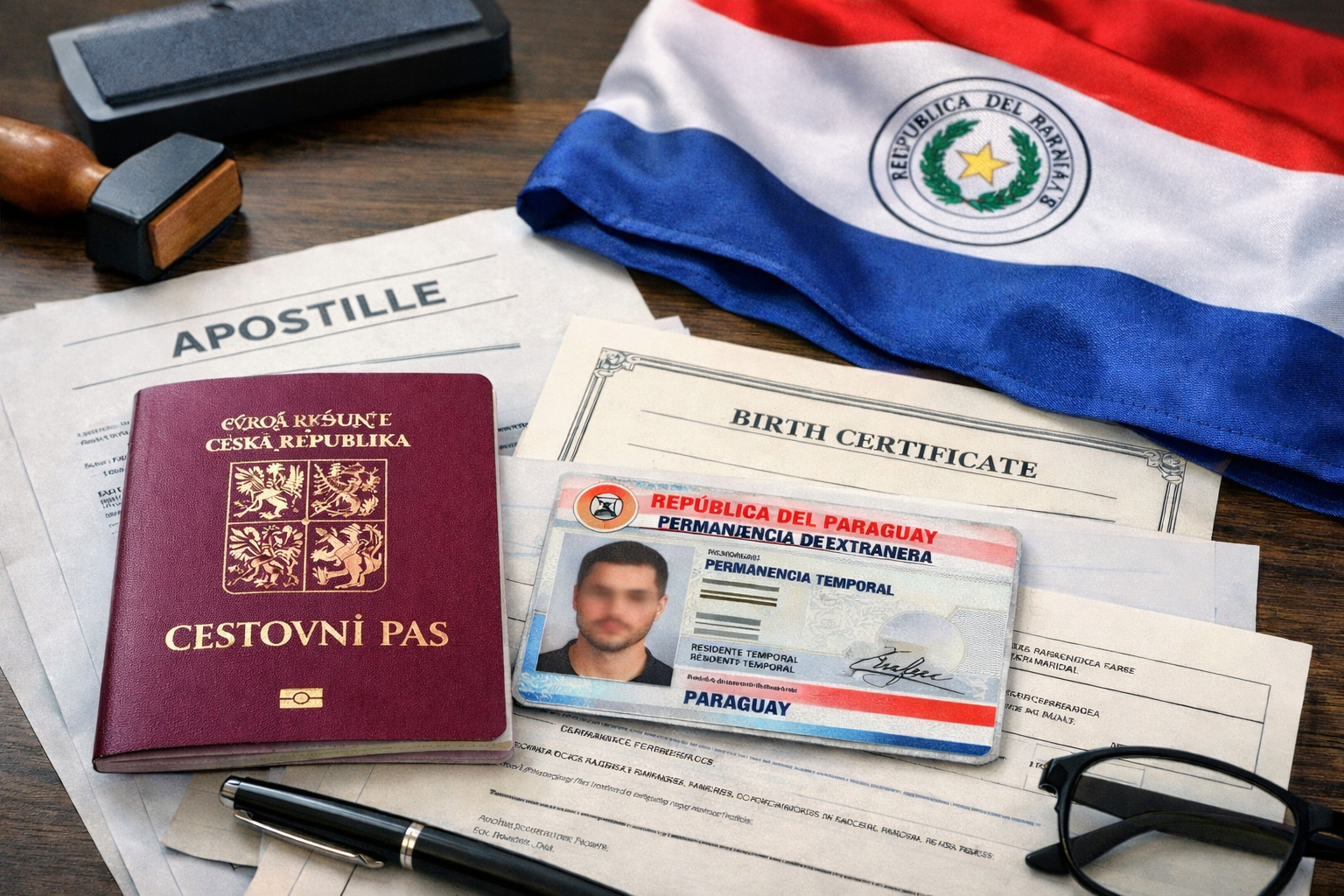
A Strategic, Tax-Efficient Second Residency for Europeans Seeking Stability, Simplicity, and Long-Term Optionality
For Czech citizens looking beyond the European Union for a legal, stable, and tax-efficient second residency, Paraguay has quietly become one of the most compelling options worldwide.
Unlike highly marketed residency programs in Southern Europe or the Caribbean, Paraguay’s system is not built on hype, minimum investment thresholds, or fast-changing political narratives. Instead, it is based on administrative clarity, low entry barriers, and long-term consistency—qualities increasingly rare in today’s global migration landscape.
This in-depth guide is written specifically for Czech citizens considering residency in Paraguay in 2026 and beyond. It covers legal structure, taxes, real estate, banking, timelines, risks, and common mistakes, all from a practical, investor-grade perspective rather than a sales pitch.
Why Czech Citizens Are Looking Beyond the EU
Citizens of the Czech Republic enjoy strong passport power and EU freedom of movement. So why consider Paraguay at all?
Because residency planning is no longer about travel freedom alone. For many Europeans, it has become about:
- Tax exposure and long-term fiscal predictability
- Asset protection and geographic diversification
- Business flexibility outside the EU regulatory environment
- A real Plan B, not just theoretical mobility
Paraguay offers a legal residence status that can coexist with Czech and EU citizenship, without forcing lifestyle changes, mandatory relocation, or high costs.

What Truly Sets Paraguay Apart from Other Residency Programs
Paraguay’s residency system differs from most global migration programs not because it is fast or heavily promoted, but because it is procedural, predictable, and structurally non-commercial.
Rather than selling residency through investment thresholds or marketing-driven schemes, Paraguay operates a documentation-based immigration framework that has remained largely unchanged for years.
Residency Is Administrative, Not Transactional
Paraguay does not operate a Golden Visa or investment-for-residency program.
There is no statutory minimum investment requirement, no obligation to purchase real estate, and no capital deployment written into immigration law. Residency is granted based on eligibility, documentation, and compliance, not on financial thresholds that can shift with political cycles.
No Ongoing Physical Presence Requirement
After residency is approved, applicants are not required to reside full-time in Paraguay to maintain their legal status, provided basic administrative obligations are met.
This allows residency to function as a strategic second residence, rather than forcing immediate relocation or lifestyle changes—an increasingly rare feature in modern migration programs.
Territorial Taxation as a Structural Feature
Paraguay applies a territorial tax system by law.
Only income sourced within Paraguay is subject to local taxation. Foreign-sourced income is outside the Paraguayan tax base, assuming correct structuring and no local source of economic activity.
This is not a temporary incentive or special regime—it is a core principle of the Paraguayan tax code.
Temporary Residency First, Permanent Residency Follows
Paraguay’s system typically begins with a temporary residency permit, usually valid for a defined period.
After meeting the required conditions and timelines, residents may apply for permanent residency, which provides long-term stability without annual renewals.
While permanent residency is not granted instantly, the transition path is clear, rule-based, and historically stable, without quota systems or investment escalation.
Why This Structure Still Remains Rare
Most countries combine:
- investment thresholds,
- strict physical presence rules,
- frequent renewals,
- and politically sensitive migration quotas.
Paraguay combines none of the above.
Instead, it offers a low-friction, low-volatility residency pathway designed for long-term legal certainty rather than short-term inflows.
That structural simplicity not speed or marketing is what continues to set Paraguay apart.
Types of Residency Available to Czech Citizens
Paraguay operates a two-stage residency framework. While often described as simple, the process follows a clearly defined administrative progression rather than a one-time approval.
Temporary Residency (Initial Status)
Czech applicants begin with temporary residency, which serves as the formal entry point into Paraguay’s immigration system.
Key characteristics:
- Temporary resident card issued upon approval
- Legal right to reside in Paraguay
- Ability to work, open bank accounts, and own property
- No statutory investment or real estate requirement
This stage establishes legal residence and creates the basis for long-term status.
Permanent Residency (Status Upgrade After the Required Period)
After holding temporary residency for the required period typically two years residents may apply for permanent residency.
Key distinctions:
- The process is an administrative status upgrade, not a new residency application
- Reduced documentation requirements compared to the initial filing
- Government fees apply, but no investment thresholds exist
- Permanent resident card issued upon approval, without renewal cycles
While the upgrade is not automatic and requires a formal request, it is procedural and predictable, provided the temporary residency was properly maintained.

Why This Matters in Practice
For Czech citizens, the transition from temporary to permanent residency is not a second screening, but a confirmation of continued eligibility.
The legal risk, documentation burden, and uncertainty are significantly lower than at the initial stage—making Paraguay one of the few jurisdictions where long-term residency becomes simpler over time, not more complex.
Legal Basis and Immigration Authority
Residency is processed through Dirección Nacional de Migraciones, the Paraguayan immigration authority.
The system is:
- Paper-based but standardized
- Rules-driven rather than discretionary
- Remarkably stable compared to many Latin American countries
This stability is one of Paraguay’s biggest advantages.
Step-by-Step Residency Process for Czech Citizens
Paraguay’s residency procedure follows a clear, sequential administrative process. While the requirements are straightforward, accuracy at each stage is critical.
This requirement mirrors the process applied to most Western jurisdictions, including Canada. If you would like to compare documentation structures across countries, see: Paraguay Residency for Canadians: Step-by-Step Guide (2026 Edition).
1. Document Preparation in the Czech Republic
Before traveling to Paraguay, applicants must prepare the following documents:
- Criminal background check (Czech police record)
- Birth certificate
- Valid passport
- Marriage certificate (if applicable)
All documents must be:
- Apostilled in the Czech Republic
- Valid and recent (authorities may reject outdated records)
At this stage, translations are not required yet.
2. Entry into Paraguay
Czech citizens may enter visa-free as tourists.
Importantly:
- Residency applications are filed inside Paraguay
- Paraguayan embassies and consulates do not process residency cases
Physical presence in Paraguay is required only for the filing and biometric stages.
3. Local Filing, Translations, and Biometrics
Once in Paraguay, the following steps take place:
- Certified Spanish translations of all apostilled documents
- Issuance of a local medical certificate
- Fingerprinting and biometric registration
- Formal submission of the residency application to immigration authorities
This stage converts prepared documents into a legally complete application.
4. Processing Period
After submission, the application enters administrative review.
Typical processing timeline:
- Approximately 3 to 6 months
- In some cases faster, depending on government workload and document quality
There is no guaranteed fast-track process, and timelines depend largely on procedural accuracy.
5. Issuance of Temporary Residency Card
Upon approval:
- A temporary resident ID card is issued
- Applicants may apply for a Paraguayan tax identification number (RUC)
- Banking, property ownership, and formal economic activity become significantly easier
Temporary residency serves as the legal foundation for long-term status and later eligibility for permanent residency.
Practical Note for Czech Applicants
While the process is often described as “simple,” most delays arise from:
- incomplete apostilles,
- incorrect translations,
- or premature assumptions about timelines.
Paraguay’s system is forgiving—but only when procedural order is respected.
Timeline Summary (Realistic Expectations)
| Stage | Estimated Time |
|---|---|
| Document prep in CZ | 2–4 weeks |
| Apostille & translation | 1–2 weeks |
| Immigration processing | 3–5 months |
| Total timeline | ~4–5 months |
There is no official “fast track”, and anyone promising a 30-day approval should be treated with caution.
Taxation: What Czech Citizens Need to Understand
This is where Paraguay becomes particularly attractive.
Paraguay Uses a Territorial Tax System
Only income generated inside Paraguay is subject to Paraguayan tax.
That means:
- Foreign salaries
- Dividends from abroad
- Rental income from foreign property
- Capital gains outside Paraguay
Not taxed locally, if structured correctly.
Does Residency Automatically Make You a Paraguayan Tax Resident?
No tax residency and immigration residency are separate concepts.
Tax residency depends on:
- Physical presence
- Center of economic interests
- Actual income source
This allows Czech citizens to:
- Hold Paraguayan residency
- Keep Czech or other tax residency
- Use Paraguay as a long-term option rather than an immediate switch
Proper international tax planning is essential. Paraguay is simple, but not careless.
Banking in Paraguay as a Czech Resident
Once residency is approved, banking becomes possible.
What You Can Expect
- Accounts in USD and local currency
- Conservative banking culture
- Strong capitalization and low leverage
- Strict compliance (KYC is serious)
What Paraguay Is Not
- It is not a crypto-friendly offshore banking hub
- It is not a secrecy jurisdiction
- It is not a quick online-only banking solution
Instead, it offers boring, stable, old-school banking – which is exactly what many Europeans want for diversification.
Real Estate Ownership for Czech Citizens
Foreigners can own 100% freehold property in Paraguay.
No:
- Restrictions
- Special permits
- Local partner requirements
Why Many Residents Choose to Buy
- Very low entry prices compared to Europe
- Strong rental demand in Asunción
- Simple ownership structure
- No annual property tax burden comparable to EU countries
Real estate is not required for residency, but it often complements long-term planning.
Cost of Living and Practical Lifestyle
Paraguay is not a luxury destination – but it is comfortable, calm, and functional.
In Asunción:
- Modern apartments available
- Private healthcare at low cost
- International schools
- Growing expat community
For Czech citizens, the lifestyle adjustment is far smaller than expected, especially compared to Asia or Africa.
Common Mistakes Czech Applicants Make
Paraguay’s residency process is often described as “simple.” In practice, most problems arise not from complexity, but from incorrect assumptions carried over from European residency and investment programs. Czech applicants, in particular, tend to repeat a small set of avoidable errors that can undermine an otherwise straightforward application.
1. Treating Residency as an Investment Transaction
Paraguay does not operate an investment-for-residency model.
There are no financial thresholds, no preferential treatment for capital deployment, and no accelerated outcomes linked to spending. Applicants who approach the process as a “Golden Visa alternative” often receive misaligned advice or are pushed into unnecessary purchases that have no legal relevance to immigration approval.
Residency in Paraguay is a legal and administrative status, not a product that can be bought, upgraded, or fast-tracked through expenditure.
2. Confusing Immigration Residency with Tax Outcomes
Obtaining residency in Paraguay does not automatically determine tax residency or eliminate foreign tax exposure.
Tax consequences depend on factual criteria—such as physical presence, economic activity, income sourcing, and business structure—not on the possession of a residence card alone. Without integrated planning, applicants risk incorrect assumptions, dual-residency conflicts, or compliance issues in their home jurisdiction.
Paraguay’s territorial tax system is a structural advantage, but only when aligned with a coherent international tax strategy.
3. Delegating the Process to Informal or Unlicensed Intermediaries
The apparent simplicity of Paraguay’s system has attracted a parallel market of informal “fixers” offering speed, certainty, or unofficial shortcuts.
These arrangements frequently result in:
- incomplete or improperly filed applications,
- documentation that cannot withstand later review,
- or unresolved issues that surface only years later.
Residency is a formal legal process with long-term consequences. Czech applicants should rely exclusively on licensed immigration professionals and qualified legal advisors with verifiable experience in Paraguayan procedures.
4. Prioritizing Speed Over Procedural Integrity
Paraguay is not a jurisdiction where pressure accelerates outcomes.
Attempts to compress timelines—by submitting partial documentation, bypassing formal steps, or relying on informal assurances—often lead to delays, re-filings, or permanent administrative flags.
The system favors accuracy, consistency, and procedural discipline. Applicants who respect this reality typically experience fewer issues and far greater long-term certainty.
IIs Paraguay Safe and Politically Stable?
From a residency and long-term planning perspective, Paraguay stands out not because it seeks attention, but because it consistently avoids volatility.
The country combines several structural characteristics that are increasingly rare in emerging markets:
- One of the lowest public debt ratios in South America, limiting fiscal pressure and policy shocks
- A conservative, low-leverage financial system, largely insulated from speculative cycles
- No modern history of mass expropriation or forced nationalization of private assets
- Immigration rules that have remained largely unchanged for decades, even during regional political shifts
Paraguay does not position itself as a regional leader or reform laboratory. It operates with deliberate institutional inertia, which reduces regulatory risk for long-term residents.
Its stability is not accidental – it is quiet by design, and that restraint is precisely its advantage.
Citizenship: Is It Possible and Is It Necessary?
Paraguayan citizenship is legally available to foreign residents, but it is not automatic and not immediate.
After several years of lawful residency – typically three years or more applicants may become eligible to apply, subject to:
- Demonstrated Spanish language proficiency
- Evidence of genuine connection and physical presence in Paraguay
- Judicial and administrative review
Importantly, citizenship is not a requirement to benefit from Paraguay’s residency framework.
Most Czech residents view citizenship as a long-term option rather than a primary objective. For many, permanent or long-term residency already delivers the legal stability, flexibility, and diversification they seek – without the obligations that citizenship entails.
Who Is Paraguay Residency Ideal For?
It works best for:
- Entrepreneurs
- Investors
- Remote business owners
- Families seeking diversification
- EU citizens planning long-term optionality
For remote workers and entrepreneurs relocating from the Czech Republic, digital nomads in Paraguay: same residency framework, better flexibility. Rather than relying on temporary visa schemes, Paraguay provides a long-term legal structure that allows professionals to establish residency with clarity and strategic tax positioning.
It is not ideal for:
- Those seeking instant tax elimination
- People unwilling to handle paperwork
- Applicants expecting luxury migration marketing
FFinal Perspective: Paraguay as a Strategic Asset, Not an Escape
For Czech citizens, residency in Paraguay is not about leaving Europe or disengaging from the European system.
It is about:
- Adding jurisdictional flexibility before it becomes urgent
- Reducing long-term regulatory and tax exposure through lawful diversification
- Creating credible options rather than reactive solutions
In a world where mobility frameworks tighten quietly and incrementally, Paraguay remains one of the few jurisdictions that still treats residency as an administrative legal right, not as a premium product sold through marketing narratives.
That structural restraint – not speed or promotion – is precisely why Paraguay continues to attract serious, long-term planners. Quietly. Consistently.
Frequently Asked Questions – Paraguay Residency for Czech Citizens
Is Paraguay residency legal for Czech citizens?
Yes. Czech citizens can legally apply for residency in Paraguay under standard immigration law. The process is administrative and does not require investment, sponsorship, or special visas.
Do Czech citizens need a visa to enter Paraguay to apply for residency?
No. Czech passport holders can enter Paraguay visa-free as tourists and complete the residency process inside the country. Applications are not handled through embassies or consulates.
Is buying real estate required to obtain residency in Paraguay?
No. Paraguay does not operate a real estate–based residency or “Golden Visa” program. Property ownership is optionaland has no legal impact on immigration approval.
Does Paraguayan residency automatically make me a tax resident?
No. Immigration residency and tax residency are separate legal concepts. Tax residency depends on factors such as physical presence, economic activity, and income source—not merely holding a residency card.
Is foreign income taxed in Paraguay?
Paraguay applies a territorial tax system. Income generated outside Paraguay is generally not subject to Paraguayan tax, provided it has no local source and is properly structured.
How long does the residency process take for Czech citizens?
From document preparation to approval of temporary residency, the process typically takes 3 to 6 months, depending on document quality and government workload.
Is permanent residency granted immediately?
No. Czech applicants usually begin with temporary residency. After holding it for the required period—typically around two years—they may apply for permanent residency through a simplified administrative upgrade.
Is the upgrade to permanent residency automatic?
No. Permanent residency is not automatic, but it does not require restarting the process from scratch. Documentation requirements are reduced, and the procedure is largely procedural if temporary residency was properly maintained.
Can Czech residents work or open a business in Paraguay?
Yes. Temporary and permanent residents may legally work, open companies, and conduct business in Paraguay, subject to standard registration and tax rules.
Can Czech citizens open bank accounts in Paraguay?
Yes, once residency is approved. Paraguayan banks are conservative and compliance-focused, but residents can open accounts in local currency and USD with proper documentation.
Is Paraguay safe and politically stable?
Paraguay is considered one of the more institutionally stable countries in South America, with low public debt, a conservative financial system, and no modern history of mass expropriation. Its immigration framework has remained stable for decades.
Do Czech citizens need to live in Paraguay full-time to keep residency?
No. There is no continuous physical presence requirement, although residents should maintain basic compliance and avoid extended unexplained absences.
Is Paraguayan citizenship possible for Czech citizens?
Yes. After several years of residency (typically 3+ years), Czech residents may apply for citizenship. Spanish language proficiency and physical presence are required. Most applicants treat citizenship as optional, not essential.
Is Paraguay residency a good “Plan B” for EU citizens?
For many Czech citizens, yes. Paraguay residency is often used as a strategic second residency, offering legal diversification, long-term flexibility, and reduced exposure to regulatory concentration.
Who is Paraguay residency NOT suitable for?
It is generally not suitable for individuals seeking:
- instant tax elimination without planning
- a luxury or lifestyle-driven migration program
- fast-track citizenship without residence
- informal or shortcut-based solutions
Should I handle the process alone or with professional support?
While the process is straightforward, most long-term issues arise from documentation errors, incorrect tax assumptions, or informal intermediaries. Professional guidance significantly reduces risk.
Professional Residency Structuring for Czech Citizens
Residency in Paraguay is simple only on the surface.
In practice, outcomes depend on correct sequencing, compliant documentation, and coordinated tax and legal planning.
Our team assists Czech citizens with:
- Legally sound residency applications, processed directly in Paraguay
- Document preparation and verification aligned with Czech and EU standards
- Residency planning integrated with international tax and asset structures
- Real estate and banking coordination, where appropriate – not as a requirement
We do not sell residency packages or investment shortcuts.
We structure durable legal status for individuals who value predictability, compliance, and long-term optionality.
If you are considering Paraguay as part of a broader residency or asset strategy, engage with professionals who understand both sides of the equation—Europe and Paraguay before assumptions turn into risk.
A well-structured residency is not about speed.
It is about getting it right once.
Paraguay Residency for Czech Citizens – Key 2026 Data
- Czech passport holders may apply for residency without a prior long-stay visa
- Typical approval timeline ranges from 90 to 120 days
- Czech criminal record extract must be apostilled before submission
- Official Spanish translations are required for foreign-issued documents
- In-person identification steps are required during processing
- Cédula issued after residency approval through Policía Nacional
Source: GetResidencyParaguay.com – Residency Advisory for EU Citizens (2026)


Leave a Reply