
A Quiet Migration Shift With Long-Term Economic Implications
At the beginning of 2026, Paraguay recorded one of the strongest signals yet that global migration patterns are quietly changing.
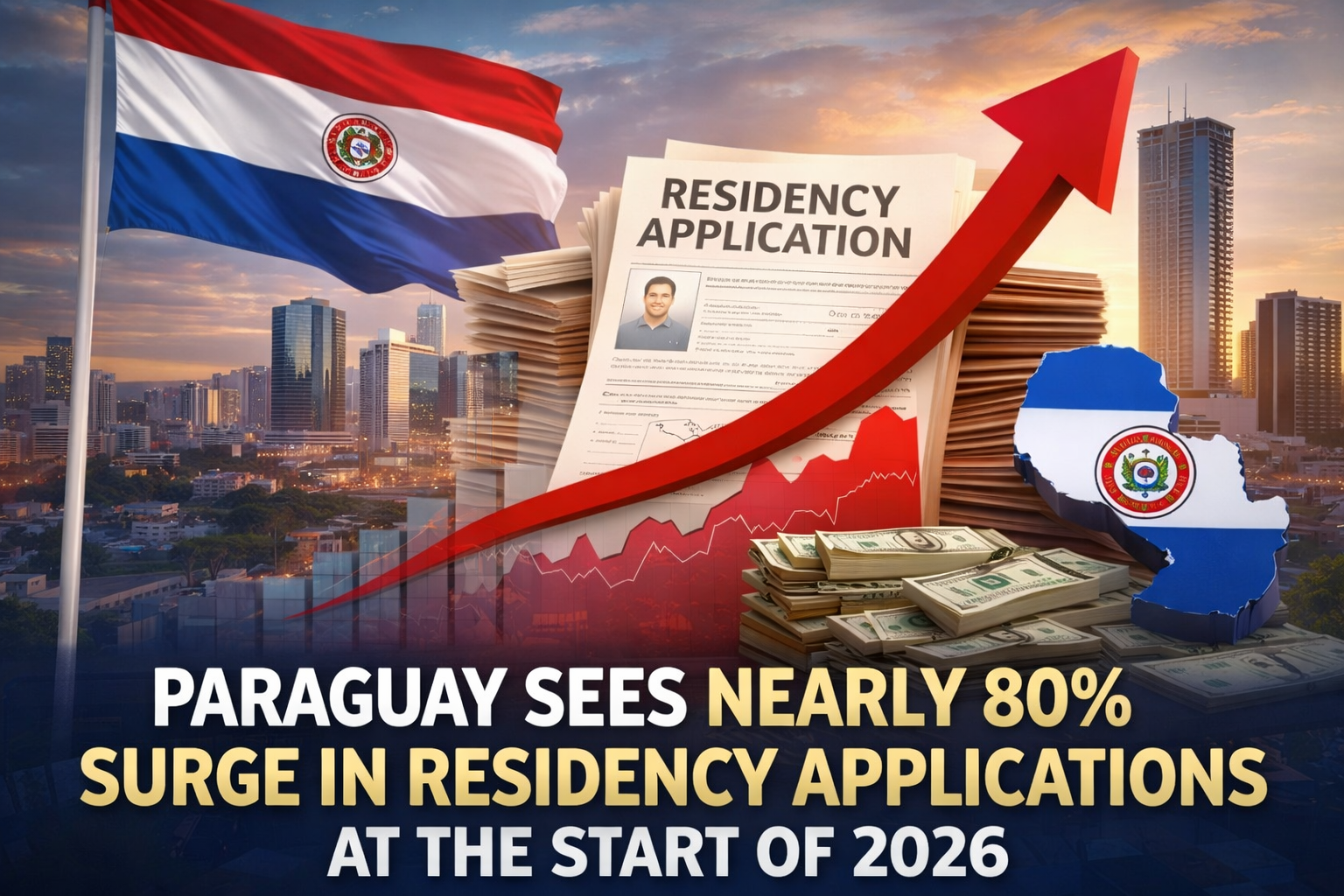
According to official data from the National Directorate of Migration (Dirección Nacional de Migraciones), residency applications surged by nearly 80% during the first weeks of January 2026, with 2,817 applications filed in just the first 20 days of the year. The figure follows an already record-breaking 2025 and confirms that Paraguay’s growing appeal is not a temporary spike but a sustained trend.
While the country rarely dominates international headlines, these numbers place Paraguay among the most quietly attractive destinations for long-term relocation in the Western Hemisphere.
A Structural Trend, Not a One-Off Spike
What makes this surge particularly noteworthy is its timing and consistency.
Migration inflows often fluctuate due to geopolitical crises, tax policy changes, or short-term incentives. Paraguay’s case is different. The sharp increase in early 2026 builds directly on momentum established throughout 2024 and 2025, suggesting structural rather than cyclical drivers.
Authorities report that demand is rising across multiple nationalities, including Europeans, North Americans, Latin Americans, and remote professionals relocating from higher-cost jurisdictions. This diversification reduces the likelihood that the trend is driven by any single regulatory loophole or regional event.
Instead, Paraguay appears to be benefiting from a broader reassessment of how—and where—people choose to live.
Why Paraguay? The Fundamentals Matter
Paraguay’s appeal does not rely on spectacle or aggressive marketing. It rests on fundamentals that increasingly resonate in a world defined by volatility.
1. Political and Monetary Stability
Paraguay has maintained relative political continuity and one of the most conservative fiscal frameworks in South America. Public debt remains low by regional standards, inflation has been comparatively contained, and monetary policy is predictable.
For individuals seeking jurisdictional stability rather than short-term arbitrage, this matters.
2. A Straightforward Residency Framework
Unlike many countries that continuously revise migration rules, Paraguay has preserved a clear and accessible residency pathway. Requirements are transparent, processing times are predictable, and administrative discretion is limited.
This clarity stands in contrast to jurisdictions where immigration systems have become increasingly politicized and opaque.
3. Paraguay Territorial Tax System
Paraguay operates under a territorial taxation model, meaning foreign-sourced income is generally not taxed locally. While individual circumstances vary and professional advice is essential, this structure is a major factor for entrepreneurs, investors, and remote professionals seeking geographic diversification.
As global tax pressure rises, simplicity itself has become a competitive advantage.
4. Cost of Living in Paraguay and Quality of Life
Paraguay continues to rank among the lowest cost-of-living countries in South America, without sacrificing urban infrastructure. Asunción offers modern residential developments, private healthcare, international schools, and a growing business ecosystem at a fraction of the cost seen in more saturated markets.
Who Is Moving and Why Now?
The profile of new residents is evolving.
Early migration waves were often dominated by retirees or regional movers. Today’s applicants increasingly include:
- Entrepreneurs and digital business owners
- High-net-worth individuals seeking geographic hedging
- Remote professionals decoupling income from location
- Families prioritizing stability, safety, and long-term optionality
What unites them is not a desire for tax avoidance alone, but a broader strategy of risk diversification—across jurisdictions, currencies, and political systems.
The nearly 80% surge at the start of 2026 suggests that many are acting before global pressures intensify further, rather than reacting after the fact.
Economic Implications for Paraguay
From a macroeconomic perspective, rising residency demand carries meaningful long-term implications.
New residents contribute to:
- Domestic consumption
- Real estate demand
- Professional services and financial activity
- Human capital inflows
Unlike speculative capital, residency-driven migration tends to be sticky. Individuals who relocate families, establish companies, and acquire property are far more likely to contribute over extended periods.
For Paraguay, this supports gradual urban development, tax base expansion through local consumption, and deeper integration into global economic networks—without the boom-and-bust cycles seen in more speculative migration destinations.
Why This Trend Is Flying Under the Radar
Despite the scale of the increase, Paraguay remains largely absent from mainstream migration narratives.
That is precisely why the data matters.
Historically, the most durable migration shifts occur quietly, long before they become fashionable. By the time a destination dominates international media, much of the asymmetric advantage has already been priced in whether in real estate, regulatory complexity, or cost structures.
Paraguay’s current phase resembles early-stage positioning rather than late-cycle hype.
Looking Ahead: What 2026 Signals
If the first weeks of 2026 are any indication, Paraguay is transitioning from an “alternative” destination to a deliberate choice for globally mobile individuals.
The nearly 80% surge in residency applications is not merely a statistic. It is evidence of a deeper recalibration in how people evaluate sovereignty, mobility, and long-term security.
In a world where optionality is increasingly valuable, Paraguay is offering something rare: stability without rigidity, access without excess, and simplicity without compromise.
Those paying attention are not rushing in they are positioning early.


Leave a Reply