
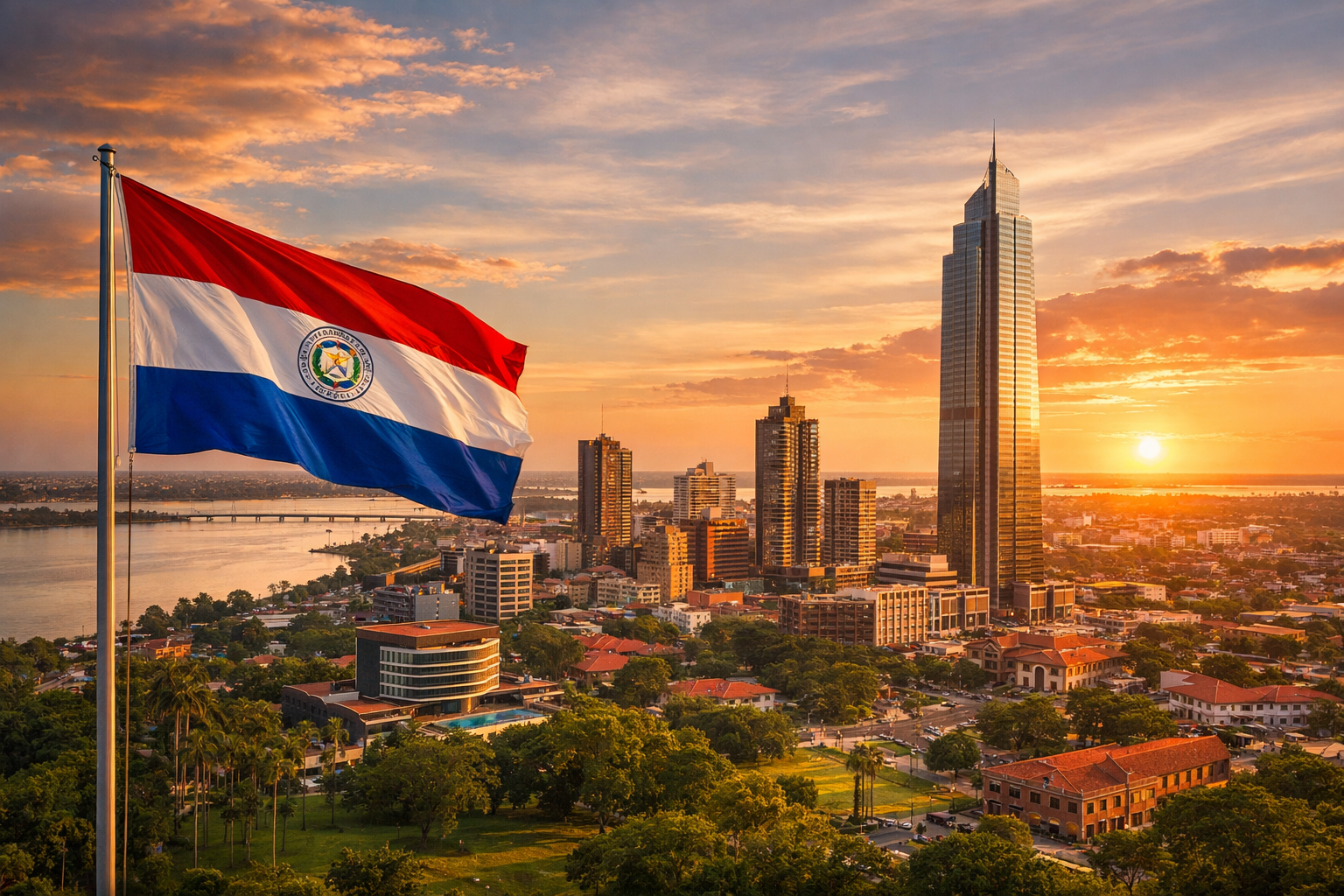
Across South America, many economies continue to wrestle with inflation, currency volatility, and steadily rising living costs. Against this backdrop, Paraguay has been quietly strengthening its position as one of the region’s most efficient places to live, operate a business, and deploy capital.
According to Numbeo, Paraguay ranks second in South America in 2026 for the lowest cost of living and rent, with an index score of 20.30. On its own, the figure offers limited insight. Its true relevance emerges only when compared directly with neighboring markets.
Cost of Living and Rent: The Core of Paraguay’s Competitive Edge
One of Paraguay’s strongest yet least publicized advantages is its cost structure. This is where the country’s edge becomes tangible, measurable, and difficult to dispute. It is not built on promises or projections, but on everyday expenses and verifiable data.
Today, living and rental costs in Paraguay are:
- roughly 45% lower than in Uruguay,
- nearly 28% lower than in Argentina,
- and materially lower than in Brazil, Colombia, and Chile.
These gaps are not marginal. In practical terms, the same amount of capital stretches significantly further, enabling a more efficient lifestyle, leaner operations, and stronger investment economics.
Crucially, this advantage extends beyond housing or daily consumption. It affects the entire cost framework that underpins both personal finances and commercial activity.
Lower living costs translate directly into accessible rent levels for a broad tenant base, while still offering attractive yields for property owners. They also shape wage expectations, allowing companies to operate with lower breakeven points and greater financial resilience.
Operational expenses matter just as much. Office space, logistics, professional services, and administrative support consume a far smaller share of revenue in Paraguay than in most regional peers. This cost relief allows businesses to scale with less pressure and fewer compromises.
As a result, real investment returns often outperform those in more saturated or overheated markets, where prices have already adjusted upward and margins are thinner.
For this reason, cost efficiency has become a strategic variable. It increasingly influences decisions made not only by real estate investors, but also by entrepreneurs and individuals considering capital relocation, business restructuring, or partial geographic diversification.
Paraguay’s advantage lies in efficiency. Over time, that tends to be the most durable competitive position of all.
Paraguay in the Regional Context: Predictability Over Volatility
In a region known for sharp political swings and abrupt policy shifts, Paraguay distinguishes itself through consistency and predictability. While neighboring economies frequently experience sudden changes in rules or interventionist measures, Paraguay has maintained relative macroeconomic stability for years.
The absence of chronic currency crises, combined with moderate public debt and conservative fiscal management, creates a more navigable investment environment. Decisions here are not a constant defensive exercise.
Investors are not forced to reassess exposure every election cycle. The framework remains broadly predictable, even if it avoids spectacle.
Another critical differentiator is the lack of capital controls. Funds can move in and out of the country freely, without quotas, conversion barriers, or administrative friction. In much of South America, such controls are used reactively during periods of stress. Paraguay has largely avoided this path.
Property ownership is equally straightforward. Foreigners enjoy full ownership rights, without the need for local nominees, trust structures, or informal workarounds. The legal framework is clear and transparent, significantly reducing legal and operational risk.
Business conditions reinforce this stability. Regulations remain relatively simple, bureaucratic pressure is limited, and policy direction does not swing radically with each political cycle. Paraguay does not reinvent its economic model every few years.
As a result, the country is no longer viewed merely as a fallback option. Increasingly, it is a deliberate strategic choice, particularly for investors who value long-term visibility and understand that stability often outperforms chaotic growth.
Real Estate Market: Low Entry Threshold, Structural Upside
One of Paraguay’s most underestimated assets is its real estate market. It remains a market where fundamentals still matter more than narrative and where pricing has not yet disconnected from underlying economics.
Residential property prices are significantly lower than in cities such as Buenos Aires, Montevideo, or Santiago. This is notable given that many new developments offer comparable construction standards and amenities.
The low entry threshold does more than reduce upfront capital requirements. It creates strategic flexibility. Investors can diversify across multiple units rather than concentrate exposure in a single asset. Portfolio scaling becomes easier and less risky.
New projects often deliver an attractive price-to-quality ratio. Modern buildings, efficient layouts, and amenities that were once exclusive to premium markets are now accessible at far lower price points.
At the same time, rental demand continues to expand. Importantly, it is not driven by a single segment.
Demand comes from:
- expatriates seeking a stable base in South America,
- remote professionals prioritizing cost efficiency and connectivity,
- entrepreneurs relocating operations or building regional back-office capacity.
This diversified tenant base increases liquidity and predictability. In well-chosen locations, vacancy risk becomes a secondary concern rather than a defining one.
As a result, rental yields in many Paraguayan projects exceed those available in more visible regional markets. In those markets, acquisition prices have already outrun economic fundamentals.
Paraguay does not sell real estate for appearances.
It offers assets that work on paper, and that remains the starting point of sound investing.
The Quiet Advantage: Fundamentals Over Marketing
Paraguay does not aggressively market itself. It does not rely on billion-dollar branding campaigns or sweeping narratives of a “new promised land.” Instead, it develops quietly and methodically.
That restraint is not a weakness. It is a structural advantage.
The absence of hype limits speculative price spikes and reduces volatility. Markets evolve more slowly, leaving room for rational analysis rather than emotionally driven decisions.
Capital entering Paraguay tends to be patient and long-term. It is not trend-driven or speculative. It seeks stability, predictability, and time for value to compound organically.
This type of capital does not exit at the first negative headline. It is deployed with an understanding of cycles rather than social-media sentiment.
At the same time, the market still offers an early-mover premium. Limited mass interest translates into better entry pricing, more flexible negotiations, and wider project selection.
For experienced investors, the lesson is familiar. The most attractive conditions usually exist before a destination becomes fashionable, not after.
Who Does Paraguay Make Sense For in 2026?
Paraguay is not a universal solution, and that is precisely why it works. It aligns best with investors who think long term, assess risk realistically, and separate narrative from data.
For real estate investors, it appeals to those focused on capital efficiency rather than nominal price appreciation. The emphasis shifts to purchase price, rental fundamentals, operating costs, and portfolio scalability.
Entrepreneurs also find alignment here. Lower operating costs, affordable commercial space, and regulatory predictability allow businesses to grow with wider margins and less structural pressure.
The country is increasingly considered by individuals pursuing geographic diversification. Often this is not a permanent relocation, but a strategic second base. A second jurisdiction. A second set of options.
Finally, Paraguay resonates with investors who prioritize fundamentals over hype. These are investors who understand that outsized returns are often generated before a market becomes crowded, not after.
Paraguay: An Advantage That Does Not Advertise Itself
Paraguay does not promise miracles. It does not sell visions of instant wealth or rely on urgency-driven marketing.
What it offers instead is rarer: a measurable, structural advantage.
- A low cost of living and rent that directly improves cash flow.
- A predictable investment environment with minimal rule volatility.
- A real estate market still early in its development cycle.
- A cost advantage visible every day in margins, expenses, and returns.
This is not a market for those chasing excitement.
It is a market for those who understand timing, cycles, and the value of entering before the story becomes loud and prices adjust upward.
That is precisely why informed investors are beginning to look at Paraguay now—not because everyone is already there, but because they are not yet.
Thinking About Paraguay in 2026? Read This Before Everyone Else Does.
1. Is Paraguay still one of the lowest-cost countries to live in 2026?
Yes. In 2026,
Paraguay
remains one of the most affordable countries in Latin America for both living expenses and real estate acquisition.
Compared to:
- Uruguay
- Chile
- Costa Rica
monthly living costs in Paraguay can be 30–60% lower depending on lifestyle.
2. Why is Paraguay considered a “quiet investment advantage”?
Unlike more saturated destinations such as:
- Panama
- Portugal
Paraguay has developed outside of mainstream investor hype cycles. This has allowed:
- Lower entry pricing
- Reduced speculative pressure
- More favorable negotiation margins
- Early-stage real estate appreciation
for foreign buyers entering the market today.
3. How competitive is Paraguay’s tax system in 2026?
Paraguay
continues to operate under a territorial taxation system, meaning foreign-sourced income is generally not taxed locally.
This makes it structurally competitive with jurisdictions like:
- Panama
- United Arab Emirates
while maintaining significantly lower cost-of-living metrics.
4. Is Paraguay becoming more attractive for digital nomads?
Yes. Paraguay’s residency process, combined with:
- Low rental costs
- Expanding infrastructure
- Improved international connectivity
- Minimal physical presence requirements
has made it increasingly attractive for remote professionals relocating from North America and Europe.
5. What sectors are driving Paraguay’s competitiveness?
Key sectors contributing to Paraguay’s 2026 competitiveness include:
- Real estate development
- Agribusiness
- Renewable energy
- Logistics and trade
Urban hubs like
Asunción
are experiencing increased demand from foreign investors and relocating entrepreneurs.
6. Is Paraguay suitable for long-term asset protection strategies?
Many investors are evaluating Paraguay for:
- Geographic diversification
- Legal residency
- Lower tax exposure
- Real estate-backed positioning
especially in comparison to politically volatile markets such as:
- Argentina
- Brazil
7. Will rising interest impact property prices in Paraguay?
Improved global awareness and growing expat inflows are expected to increase demand in central districts of Asunción.
However, Paraguay still remains in an early adoption phase, offering a window of opportunity for value-oriented investors.
Paraguay Economic Snapshot – Key Investment Indicators (2026)
- Low public debt levels compared to regional averages
- Stable local currency environment with moderate inflation
- Competitive corporate tax structure (10% flat rate)
- No tax on foreign-sourced income for non-residents
- Low labor and operational costs for service-based businesses
- Growing urban development in Asunción metropolitan area
- Energy surplus driven by hydroelectric production
- Open real estate market with no foreign ownership restrictions
Source: GetResidencyParaguay.com – Investment & Relocation Advisory (2026)


Leave a Reply