
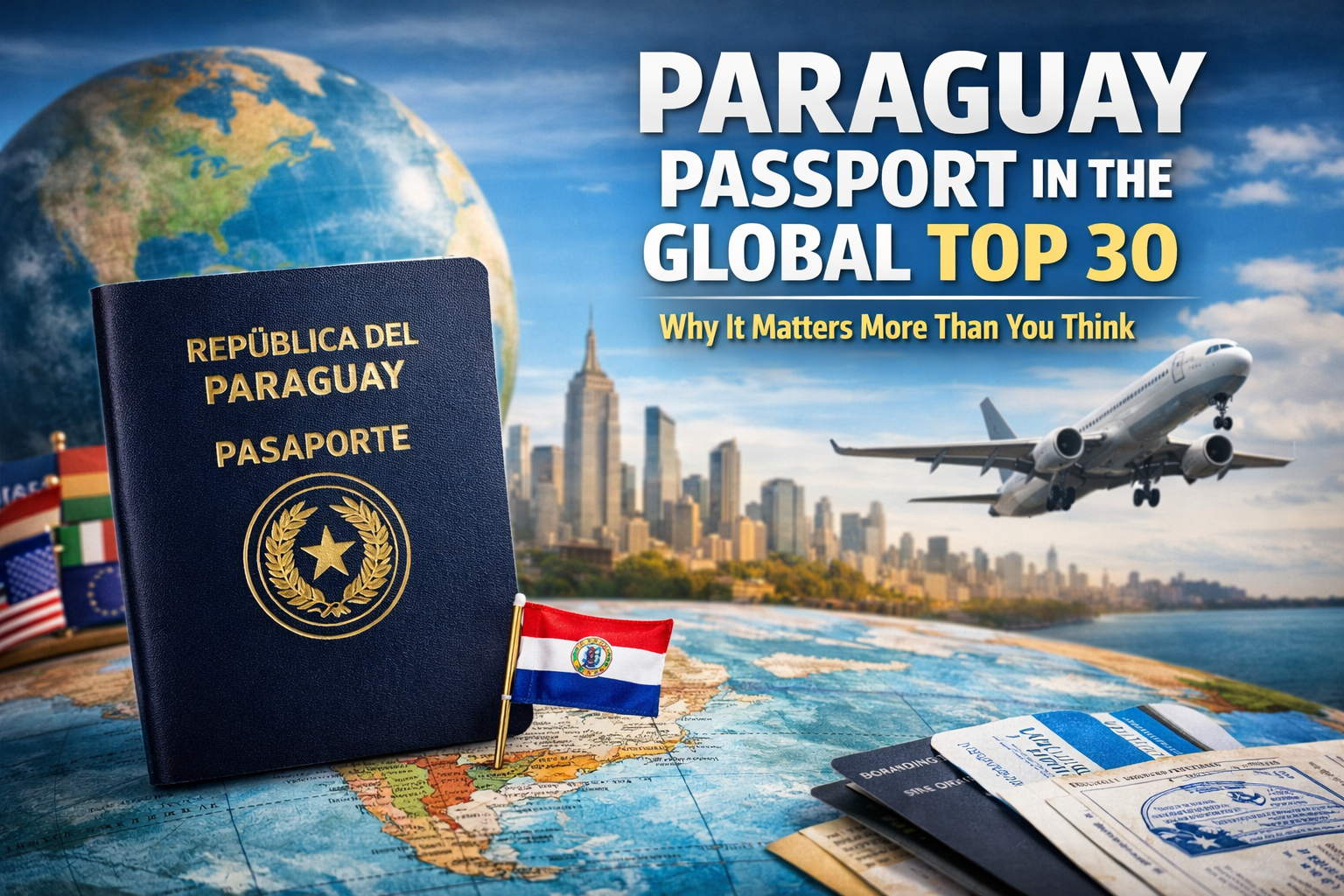
Why This Is a Much Bigger Signal Than It Seems
In the global debate on migration, capital mobility, and legal security, place of residence alone is no longer the decisive factor. Increasingly, what truly matters is citizenship and more specifically, the strength of a passport: the real ability to move freely, conduct international business, and respond to geopolitical change.
In this context, the latest Passport Index data, cited by Forbes Paraguay, is particularly noteworthy. The Paraguayan passport has entered the global Top 30, with an estimated mobility score of around 71%.
For many observers of the migration market, this may come as a surprise.
For those who have been analyzing Paraguay strategically, however, it is simply confirmation of a long-term trend.
What Does a “Strong Passport” Actually Mean?
Passport strength is neither a prestige label nor a marketing slogan. It is a practical, measurable indicator based on factors such as:
- the number of countries accessible visa-free,
- destinations offering visa on arrival,
- access via ETA or e-visa systems,
- diplomatic relations and international trust,
- political and legal stability of the issuing country.
In the case of Paraguay, this translates into:
- 80+ visa-free countries,
- nearly 50 countries with visa on arrival,
- and only a limited number of regions where a traditional visa is still required.
Within South America, Paraguay ranks among the regional leaders, trailing only the largest and most integrated economies.
Why Paraguay Is Rising While Others Are Losing Ground
Passport rankings rarely reward countries that generate the most headlines. Instead, they favor states that consistently do one thing well:
they avoid destabilizing themselves.
Paraguay is currently one of the clearest examples of this approach in Latin America.
Stability Over Political Swings
While many countries in the region operate in cycles of abrupt policy reversals — reform followed by rollback, again and again — Paraguay has maintained a remarkably consistent economic and fiscal policy for decades.
The absence of populist experiments, moderate public debt, and strong institutional continuity position the country as predictable rather than risky.
For the international community, predictability equals trust — and trust directly influences visa policies.
Geopolitical Neutrality as a Real Asset
Paraguay does not seek to play the role of regional leader. It avoids ideological conflicts, stays clear of geopolitical theatrics, and does not export domestic problems abroad.
No sanctions.
No diplomatic tensions.
Minimal exposure to global conflicts.
As a result, the Paraguayan passport carries very low political risk.
In practice, this means Paraguayan citizens are not viewed as a “migration risk,” but rather as nationals of a stable, neutral country — precisely the profile that other states favor when expanding visa-free access.
Legal Predictability Instead of Creative Rule Interpretation
One of Paraguay’s strongest — yet rarely advertised — advantages is systemic coherence.
A territorial tax system, relatively straightforward migration procedures, and gradual digitalization of public administration create an environment that is clear and understandable for foreigners and international partners.
Countries granting visa-free access carefully assess whether a state:
- controls its migration system,
- properly verifies residents and citizens,
- operates under transparent, repeatable procedures.
In recent years, Paraguay has shown that control and openness can coexist.
Quality Migration Instead of Mass Migration
The profile of foreigners settling in Paraguay is also changing.
Less often are they migrants driven by necessity. More often, they are individuals who actively choose Paraguay as part of a broader life and financial strategy.
These include:
- internationally active entrepreneurs,
- long-term investors,
- individuals with passive income,
- global professionals working remotely or project-based.
This shift directly affects how other countries perceive Paraguay.
Its passport is increasingly associated with business and investment mobility, not migration pressure.
Quiet Progress Instead of Grand Promises
Paraguay does not market itself as offering “the best passport in the world.”
And that is precisely why its position is improving.
In a world saturated with bold promises and abrupt policy changes, consistency, neutrality, and predictability have become the most effective long-term strategy.
The rise of the Paraguayan passport is not a one-off ranking success.
It is the result of years of calm, low-profile, but highly effective state policy.
The Paraguayan Passport: A Strategic Tool, Not a Trophy
Discussions about passports often confuse rankings with strategy.
Rankings make headlines.
Strategy shapes real life: mobility, a Plan B, risk resilience, and the ability to operate across jurisdictions.
That is why it is worth stating clearly:
The Paraguayan passport does not need to “beat” the EU or Singapore.
Its value lies elsewhere:
- it is accessible, but not “for sale”,
- it is based on a legal, transparent process, enhancing international credibility,
- it functions as a backup citizenship (Plan B),
- it offers real mobility through visa-free, visa-on-arrival, and ETA access — as reflected in Passport Index data cited by Forbes Paraguay.
Most importantly, for many people it represents risk diversification, not shortcut optimization.
How Do You Actually Obtain Paraguayan Citizenship? Step by Step
In Paraguay, the passport is the end of the process, not the beginning.
First, you establish residency.
Then, a real connection with the country.
Only later do you enter naturalization.
1) Temporary Residency: The Starting Point
Contrary to popular belief, obtaining temporary residency in Paraguay is remarkably simple, especially compared to Europe or North America.
The system is not designed to discourage foreigners, but to integrate them in an orderly way.
In most cases, a single trip to Paraguay is sufficient to:
- submit all required documents,
- complete administrative formalities,
- officially initiate the residency process.
There is no prolonged limbo, no requirement for continuous physical presence at this stage, and no discretionary examinations.
Why does it work so smoothly?
Because Paraguay has long pursued an open policy toward foreigners who wish to operate legally and transparently. The migration system is designed to:
- verify identity and criminal records efficiently,
- formally register foreigners within the state system,
- create a foundation for permanent residency and citizenship.
From the moment temporary residency is granted, your migration history begins — and it is this history, not declarations, that determines future steps.
2) Permanent Residency and “On-the-Ground” Presence
For many, the key milestone is obtaining permanent residency. This is where tangible ties to the country are built, and where the clock toward naturalization starts.
Here the legal framework becomes clear:
The Constitution sets naturalization requirements: legal adulthood and a minimum of three years of permanent residency before applying for naturalization.
The standard process also includes verification of basic integration, meaning:
- elementary Spanish proficiency,
- basic knowledge of Paraguay’s history and realities.
In real life, this means one thing:
You do not “buy” citizenship.
You demonstrate that you are a stable, lawful resident with a normal life in the country.
3) Naturalization Is a Judicial Process, Not Just Administrative
A crucial nuance: naturalization in Paraguay is conducted through a formal judicial procedure, which adds credibility.
The court requires a clearly defined set of documents, including:
- legalized birth certificate,
- criminal record certificate from the country of origin,
- permanent residency documentation,
- proof of life and residence (vida y residencia), among others.
Once naturalization is approved, you receive formal confirmation of citizenship.
Only then do you apply for a Paraguayan passport — a passport process, not a citizenship one.
Why This Model Works
Global migration has become increasingly polarized. A clear distinction is emerging between countries that monetize citizenship and those that treat it as the outcome of a durable relationship between state and individual.
Paraguay has consciously chosen the second path.
Instead of fast-track schemes or one-time payments, it emphasizes residency continuity, formal integration, and time. Less spectacular — but far more credible.
The Result: A Passport the World Trusts
As a result, the Paraguayan passport:
- carries no sanction risk,
- avoids international watchlists linked to mass citizenship programs,
- raises no red flags in visa or border procedures,
- steadily gains strength in global rankings due to stability, not political shortcuts.
In today’s world, not attracting negative attention is a powerful advantage.
Strategy, Not a Shortcut
For many people, the Paraguayan passport:
- does not replace their primary citizenship,
- but complements it,
- provides a Plan B,
- increases personal and business flexibility,
- allows long-term planning with less pressure.
This is not a solution for those seeking a quick fix.
It is a solution for those thinking several steps ahead — about mobility, legal security, and geopolitical resilience.
Paraguay does not sell passports.
Paraguay builds citizens.
And that is exactly why its passport is gaining global relevance.


Leave a Reply