
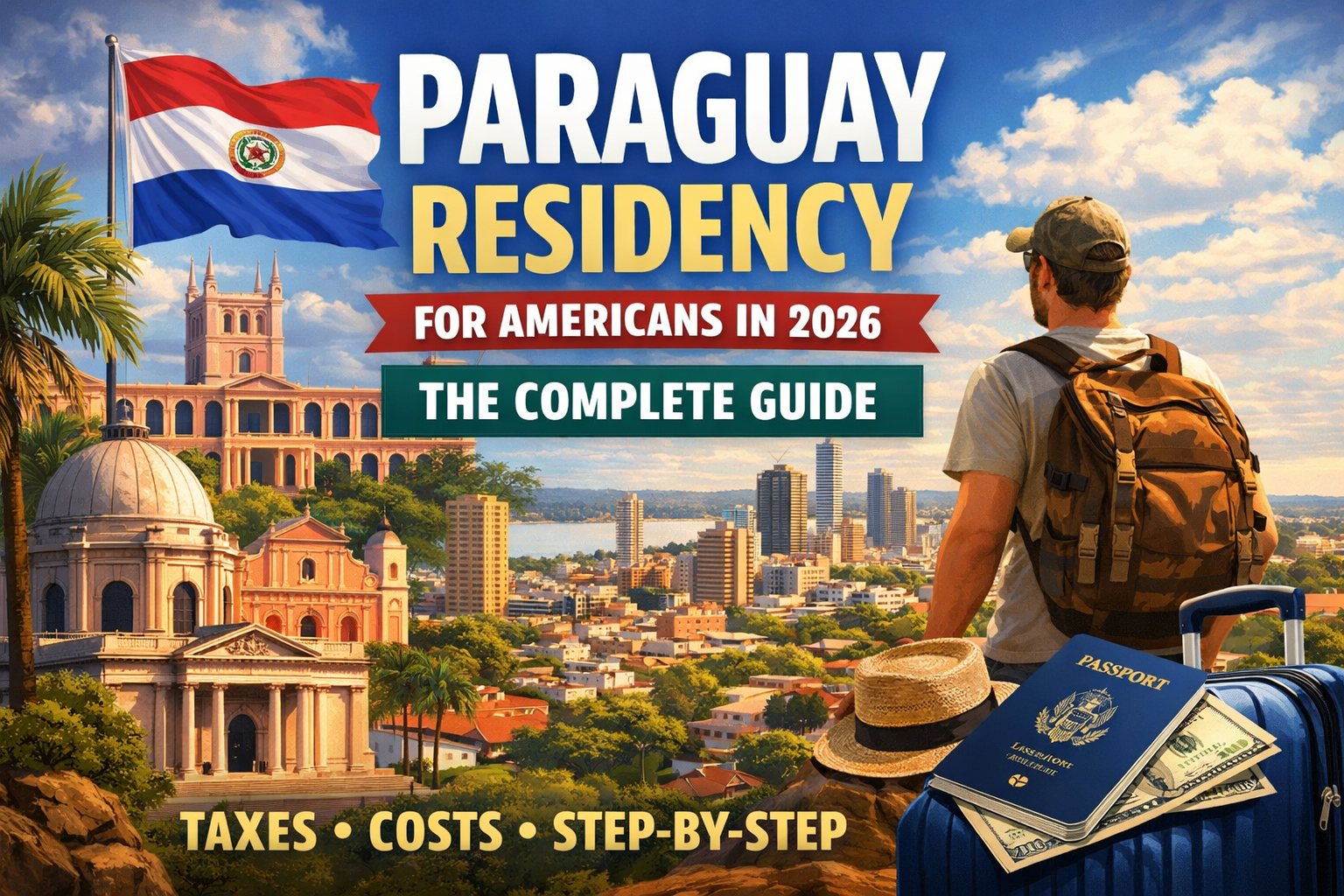
For many Americans, the question in 2026 is no longer whether to look abroad, but where. Rising tax pressure, increasing compliance complexity, and a more mobile way of working have pushed US citizens to explore legal residency options outside the United States. What most people want is not a lifestyle fantasy or a risky workaround, but a clear, lawful, and flexible solution.
Paraguay has quietly emerged as one of the most compelling answers. With a territorial tax system, one of the simplest residency processes in the world, no minimum stay requirements, and low overall costs, it offers Americans something rare: options without obligations. This guide explains exactly how Paraguay residency for US citizens works in 2026 covering taxes, costs, timelines, and common mistakes so you can decide, based on facts, whether moving to Paraguay from the USA makes strategic sense for your situation.
This is not a sales pitch and not tax advice. It is a practical, experience-based overview designed for Americans who want clarity before making decisions that affect their freedom, finances, and long-term plans.
Why Americans Choose Paraguay in 2026
Because Paraguay solves problems Americans actually have in 2026.
Rising tax pressure in the US, global reporting obligations, and shrinking flexibility have pushed many Americans to look for a legal Plan B residency—not to escape the system, but to regain options. At the same time, remote work has made location independence real, allowing professionals, founders, and investors to live and operate globally.
Paraguay stands out because it combines a territorial tax system, one of the simplest residency processes in the world, and no minimum stay requirement to keep residency—a rare and powerful combination. Unlike Europe or the Caribbean, Paraguay does not force Americans into high costs, long processing times, or rigid physical-presence rules.
Add to that a low cost of living, full property ownership for foreigners, and easy access to real assets, and the appeal becomes obvious: Paraguay is not a lifestyle experiment—it’s a strategic residency choice for Americans who value flexibility, legality, and long-term optionality.
What Is Paraguay Residency? (Quick Overview for US Citizens)
Paraguay residency is a legal immigration status, not a citizenship or investment program. For US citizens, it provides the right to live in Paraguay, obtain a local ID, open bank accounts, and access the local system—without the obligation to reside in the country full-time. The process typically begins with temporary residency and later converts into permanent residency, which does not expire. Any US passport holder with a clean criminal record can apply directly, with no sponsorship, quotas, or minimum income requirements. Most importantly, immigration residency does not automatically equal tax residency. For Americans, this distinction is critical: holding Paraguayan residency alone does not make you a Paraguayan tax resident, as tax residency depends on separate factors such as physical presence and economic ties.
Paraguay vs Puerto Rico vs Panama vs Portugal (2026 Comparison)
Americans considering a move abroad usually compare a short list of jurisdictions that promise tax efficiency, legal certainty, and lifestyle flexibility. In 2026, Paraguay, Puerto Rico, Panama, and Portugal remain the most common options—but they serve very different profiles.
Paraguay stands out for its territorial tax system, low cost, and exceptionally simple residency process. There is no investment requirement and no minimum stay to maintain residency, making it ideal for Americans who want flexibility without committing to full relocation. Panama also uses a territorial tax system, but residency is more procedural, costs are higher, and physical presence is required to maintain status.
Puerto Rico is often misunderstood. While it can offer substantial US tax benefits, it comes with strict presence rules, high living costs, and complex compliance requirements. It only makes sense for Americans who are ready to relocate full-time and meet all IRS and local conditions. For most globally mobile professionals, it is far less flexible than advertised.
Portugal, especially post-NHR, has lost much of its appeal for tax-driven Americans. It operates under worldwide taxation, requires significant physical presence, and has become more expensive and bureaucratic. For those prioritizing European lifestyle over tax efficiency, it may still appeal—but not as a strategic residency base.
Key takeaway for Americans: Paraguay wins on flexibility, simplicity, and cost control. It offers a legal second residency without forcing lifestyle changes, while alternatives either demand full relocation, higher costs, or tighter compliance.
Taxes for US Citizens Living in Paraguay
This is the most important—and most misunderstood—part of the decision. For Americans, moving or obtaining residency abroad does not mean escaping US taxes. Paraguay can be a powerful piece of the puzzle, but only if the rules are understood correctly.
US tax obligations: the reality check.
The United States taxes its citizens on worldwide income, regardless of where they live. Living in Paraguay or holding Paraguayan residency does not change that. US citizens must continue filing annual IRS returns and remain subject to reporting requirements such as FBAR (foreign bank accounts) and FATCA disclosures. In certain cases, the Foreign Earned Income Exclusion (FEIE) may apply, but only if strict physical-presence or bona fide residence tests are met. Paraguay residency alone does not qualify you automatically.
How the Paraguayan tax system works.
Paraguay operates under a territorial tax system, which is the key difference compared to Europe or many other destinations. In simple terms, income generated outside Paraguay is generally not taxed locally. Local income tax rates are low by international standards, and there is no wealth tax. Capital gains and dividends are taxed only when sourced in Paraguay. For Americans earning income abroad or online, this makes Paraguay one of the cleanest and most predictable jurisdictions from a local-tax perspective.
Can Paraguay reduce your US taxes?
Paraguay does not magically eliminate US tax obligations—and anyone promising “zero tax” is misleading you. What it can do is create legal flexibility. By combining Paraguay’s territorial system with proper US tax planning, Americans may reduce overall exposure, avoid additional layers of foreign taxation, and keep structures simple. The key is understanding what Paraguay can and cannot do—and knowing when professional tax planning is essential. Used correctly, Paraguay is not a loophole, but a strategic base within a compliant global setup.
Step-by-Step: Paraguay Residency Process for US Citizens
The residency process in Paraguay is administrative, predictable, and far simpler than most Americans expect—provided the documents are prepared correctly. The biggest mistakes usually happen before arriving in Paraguay.
Step 1: Document preparation in the United States.
US citizens must obtain an FBI background check, which then needs to be apostilled in accordance with the Hague Convention. Depending on the case, a birth certificate may also be required, likewise apostilled. These documents must be recent and properly formatted; errors at this stage are the main cause of delays later.
Step 2: Arrival in Paraguay.
Americans enter Paraguay as tourists and must provide standard entry documentation. A local address (temporary accommodation is sufficient) is required for registration purposes, along with basic local enrollment steps. No long-term lease or property purchase is necessary.
Step 3: Application filing.
The residency application is submitted in person at the immigration office. This includes local paperwork, document verification, and biometric data (fingerprints and photo). Once filed, the application is formally in process and legally recognized.
Step 4: Residency approval.
In 2026, realistic timelines range from 4 weeks to a 2 months, depending on case complexity and document readiness. Upon approval, applicants receive legal residency status and can obtain a Paraguayan ID card.
Banking, Real Estate & Life Setup for Americans
For many Americans, residency is only useful if it translates into real-world functionality. Paraguay scores well here—provided expectations are realistic.
Banking.
Yes, US citizens can open bank accounts in Paraguay, but FATCA applies. Paraguayan banks do work with Americans, though compliance is stricter and onboarding can take longer than for non-US nationals. In practice, residency significantly improves approval chances. Accounts can be held in USD or Paraguayan guaraní (PYG); USD accounts are commonly used for savings and international transactions, while PYG accounts cover local expenses. Paraguay is not a ‘bank secrecy haven’—it is a compliant system, which is exactly why it works long-term.
Real estate.
Foreigners, including Americans, can own property in Paraguay with the same rights as locals—no restrictions, no special permits. Residency is not legally required to buy real estate, but it simplifies banking, contracts, and long-term ownership. Asunción remains one of the most accessible capital cities in the region: modern apartments typically start well below prices seen in Panama, Mexico, or Europe, making Paraguay attractive for both lifestyle buyers and long-term investors.
Life setup.
With residency, Americans can integrate smoothly—secure housing, utilities, mobile plans, and private healthcare without friction. Combined with low living costs and straightforward property ownership, Paraguay offers a practical, no-nonsense setup rather than a speculative expat experiment.
Summary: Is Paraguay Worth It for Americans in 2026?
For US citizens, Paraguay is not about escaping rules or chasing hype it’s about regaining flexibility in a compliant, realistic way. It offers one of the simplest residency processes in the world, a territorial tax system that avoids double taxation at the local level, no minimum stay requirements, and low entry costs compared to Europe or the Caribbean. Americans can secure legal residency, maintain global mobility, access banking and real estate, and build a functional second base without uprooting their lives or locking themselves into rigid obligations.
In short: Paraguay works because it is simple, flexible, and honest about what it can—and cannot—do for Americans. That’s exactly why, in 2026, it remains one of the most strategic residency options available.
While U.S. citizens often focus on tax implications due to citizenship-based taxation, Canadian applicants face a different compliance landscape. If you are applying from Canada, the procedural timeline and required documents are explained in detail here: Paraguay Residency for Canadians: Step-by-Step Guide (2026 Edition).
Frequently Asked Questions – Paraguay Residency for US Citizens
1. Do US citizens need to live in Paraguay to keep residency?
No. One of the biggest advantages of Paraguay is that there is no minimum stay requirement to maintain residency. US citizens can obtain and keep Paraguayan residency without living in the country full-time. This makes Paraguay ideal as a Plan B residency or legal base for globally mobile Americans.
2. Does Paraguay residency automatically make me a tax resident?
No. Immigration residency and tax residency are not the same. Holding Paraguayan residency alone does not automatically make you a Paraguayan tax resident. Tax residency depends on factors such as physical presence and economic ties. This distinction is critical for US citizens and is often misunderstood.
3. Will Paraguay residency eliminate my US tax obligations?
No. US citizens are taxed on worldwide income, regardless of where they live. Paraguay residency does not remove IRS filing requirements, FBAR, or FATCA obligations. However, Paraguay’s territorial tax system can help avoid additional layers of foreign taxation and may support proper, legal tax planning when structured correctly.
4. Can Americans open bank accounts in Paraguay?
Yes, US citizens can open bank accounts in Paraguay, especially once residency is granted. FATCA applies, so compliance checks are stricter and processing may take longer than for non-US nationals. Accounts can be held in USD or Paraguayan guaraní (PYG), depending on usage.
5. Can US citizens buy real estate in Paraguay?
Yes. Americans can own property in Paraguay with the same rights as locals, with no restrictions on ownership. Residency is not legally required to buy property, but it significantly simplifies banking, transactions, and long-term asset management. Entry-level properties in Asunción start from around $45,000, making Paraguay one of the most accessible markets in the region.
6. How long does the residency process take in 2026?
With proper preparation, the process typically takes 5 weeks to a 2 months. The most common delays occur during document preparation in the US (FBI background checks and apostilles). Once the application is filed in Paraguay, the process is largely procedural and predictable.
7. Is Paraguay safe and practical for Americans?
Paraguay is politically stable and widely considered safe when basic precautions are followed, especially in Asunción and major residential areas. The country offers low living costs, private healthcare, modern infrastructure, and a growing expat community. For Americans seeking practicality rather than hype, Paraguay offers a balanced and functional environment.
Get in Touch – Residency & Real Estate in Paraguay
If you’re considering Paraguay residency or real estate investment in Asunción, we’re here to help. In 2025 alone, we assisted dozens of Americans in legally settling in Paraguay or investing in some of the best-performing properties in Asunción, with entry prices starting from $45,000.
We work with trusted local professionals and provide end-to-end support from residency planning and documentation to selecting, purchasing, and managing real estate. Whether your goal is a flexible second residency, a strategic base in South America, or a long-term investment opportunity, we focus on practical solutions, transparency, and results.
📩 Contact us today to discuss your situation and explore how Paraguay can fit into your residency and investment strategy.


Leave a Reply