
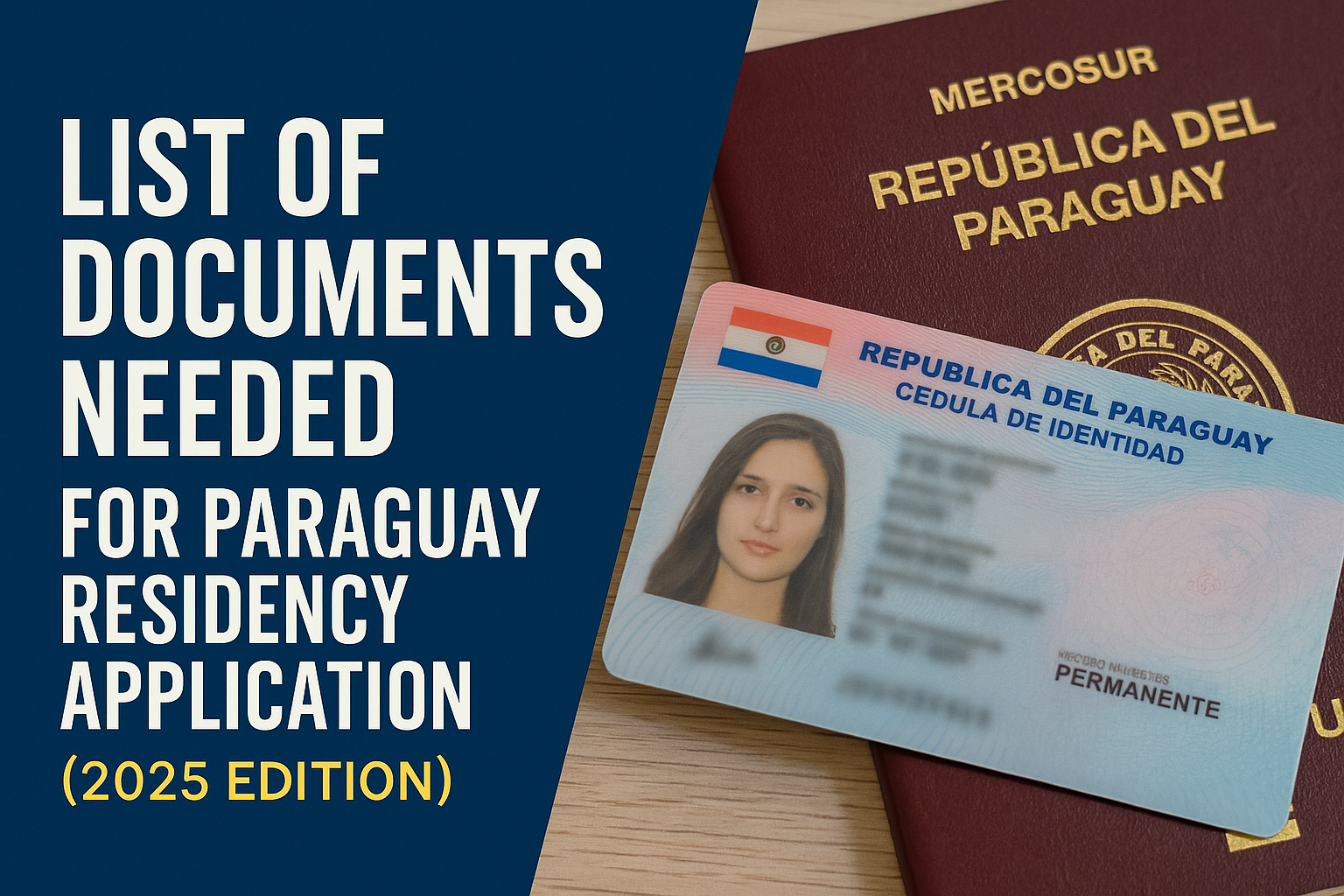
If you are preparing a Paraguay Residency Application, organizing the correct documents is the single most important step in the entire process. Incomplete, expired, or improperly legalized paperwork remains the number one reason for delays and rejections at Paraguayan immigration.
Paraguay offers one of the most accessible residency programs globally, but the simplicity of the system does not mean flexibility with documentation. Apostilles, issue dates, certified translations, and document consistency are strictly enforced by the Dirección General de Migraciones.
In this updated 2026 expert guide, you’ll find the official document checklist for a Paraguay Residency Application, along with practical insights based on real cases from applicants across more than 30 countries.
What Documents Are Required for a Paraguay Residency Application?
Below is the complete and current list of documents required to file a successful Paraguay Residency Application in 2026.
1. Valid Passport (Core Requirement)
Your passport is the foundation of your Paraguay Residency Application and must meet all of the following conditions:
- Valid for at least 6 months beyond your entry date
- In good physical condition (no damage or missing pages)
- Original passport + 1–2 clear photocopies of the ID page
All personal data (full name, date of birth, nationality) must exactly match the information on your other documents.
Important:
If you hold multiple citizenships or your name has changed, additional supporting documents (name change certificate or affidavit) may be required.
Expert Tip:
If your passport expires within the next 12 months, renew it before starting your Paraguay Residency Application to avoid complications when issuing your Cédula.
2. Criminal Background Check (Police Certificate)
A clean criminal record is mandatory for every Paraguay Residency Application.
You must provide:
- A national-level criminal background check from your country of citizenship
- Additional certificates from any country where you lived more than 6 months in the last 5 years
Document rules:
- Issued within 90 days of submission
- Apostilled (Hague Convention) or legalized via Paraguayan consulate
- Translated into Spanish by a certified translator in Paraguay
Not accepted:
Local, city, or state police certificates.
Common delay risk:
This is statistically the most problematic document due to processing times and apostille delays. Start early.
3. Birth Certificate (Apostilled & Translated)

Your birth certificate confirms your legal identity and nationality for your Paraguay Residency Application.
Requirements:
- Issued by the official civil registry
- Apostilled or consular legalized
- Translated into Spanish in Paraguay
Best practice:
- Issue date within 6 months
- Clear stamps, signatures, and registration numbers
Why it matters:
Even small inconsistencies (middle names, accents, spelling) can trigger manual review.
4. Marital Status Documents (If Applicable)
Required only if applicable to your situation:
- Marriage certificate
- Divorce decree
- Death certificate (widowed applicants)
All documents must be apostilled/legalized and translated.
Single applicants:
In some cases, a sworn single-status affidavit prepared in Paraguay is accepted.
5. Local Documents Issued in Paraguay (Handled Locally)
Every Paraguay Residency Application includes mandatory local documents, obtained after arrival:
- Interpol clearance (Paraguay)
- Local police background certificate
- Medical certificate from approved clinic
- Immigration application forms
- Biometric photos
💡 Good news:
These steps are completed in 1–2 business days with professional assistance.
6. Power of Attorney (Optional but Highly Recommended)
If you don’t want to remain in Paraguay during processing, a Power of Attorney allows your application to continue remotely.
With PoA, we can:
- Submit and monitor your Paraguay Residency Application
- Attend immigration appointments
- Collect your residency resolution
- Apply for and pick up your Cédula
This option is ideal for digital nomads, investors, and entrepreneurs.
7. Additional Documents (Case-Dependent)
Depending on the applicant’s profile and residency strategy, Paraguay’s immigration authority (DNM) may request additional supporting documents. There is no rigid checklist — each application is reviewed individually.
Entrepreneurs / Freelancers
In business-based or self-employment cases, authorities may request:
- Paraguayan company documentation (RUC, bylaws)
- Proof of economic activity, contracts, or business operations
These documents are not always required but may be requested to confirm the declared profile.
Financially Independent Applicants
For applicants relying on personal assets or passive income, possible requests include:
- Proof of income, savings, or investments
- Lease agreement or local address confirmation in Paraguay
There is no fixed minimum income threshold; documents are assessed on a case-by-case basis.
Family Applications
When applying with family members, standard additional documents may include:
- Birth certificates of children
- Marriage certificate
- Travel or residency authorizations for minors, where applicable
Final Thoughts: Prepare Once, Apply Correctly
A Paraguay Residency Application is straightforward – only if documents are prepared correctly.
When paperwork is:
- Current
- Properly apostilled
- Professionally translated
- Submitted in the correct order
…the process is smooth, predictable, and efficient.
FAQ: Additional Documents in Paraguay Residency Applications (Expert Version)
1) Does Paraguay legally require additional documents for residency?
There is no universal legal obligation, but Paraguayan immigration law grants administrative discretion to request additional documents when necessary to assess the applicant’s profile, intent, or credibility.
In practice, this means:
- no rigid checklist beyond the core requirements
- additional documents are procedural, not punitive
2) On what legal basis can DNM request extra documents?
DNM operates under administrative law, not a points-based immigration system. Officers may request supplementary documentation to:
- clarify inconsistencies
- verify declared circumstances
- establish factual residence, economic independence, or family status
This discretion is lawful and standard in Latin American immigration systems.
3) Are additional documents common or exceptional?
They are situational, not automatic.
Additional requests are:
- uncommon in single, straightforward applications
- more frequent in family cases, business-linked profiles, or complex financial situations
Well-structured files often pass without extra requests.
4) What documents are typically required for children?
For minors, DNM may request:
- birth certificates
- parental consent or custody documentation
- travel or residency authorizations
Requirements depend on:
- age
- whether both parents apply
- custody arrangements
5) When is a minor travel or residency authorization required?
It is typically required when:
- one parent applies without the other
- parents are divorced or separated
- custody is not jointly documented
This is a child protection measure, not an immigration barrier.
6) Must documents be translated into Spanish?
Generally, yes, when documents are not in Spanish.
DNM usually requires:
- apostille or legalization
- sworn Spanish translation (by an authorized translator)
Requirements vary slightly by document type but translations are common practice.
7) What most often triggers a request for additional documents?
The most frequent triggers are:
- inconsistent names or dates
- unclear civil status
- vague income declarations
- missing address confirmation
- outdated or borderline-valid documents
Not suspicion — clarification.
Let Us Handle the Details — So You Can Focus on the Bigger Picture
At Get Residency Paraguay, we’ve helped clients from over 30 countries prepare, legalize, and submit their residency applications with complete confidence. From document apostille assistance abroad to local procedures, certified translations, company formation, and Power of Attorney — we manage everything.
Whether you’re planning to relocate permanently, create a Plan B residency, or establish tax residency in a low-obligation jurisdiction, we’re here to guide you through every step.
📩 Contact us today to receive your personalized document checklist and consultation!


Leave a Reply